10 November 2008

Monday Art

For no particular reason, I thought it was a good day to post another one of these:


I named it "ducks" and then had to look at the picture for a while to figure out why I'd named it ducks. Incidentally, this is much easier to do with a touchpad than it is with a mouse (and would probably be easier still with an actual pen/stylus pad, if I had one). This one was done using a mouse. I can't get as many tight twists in when using a mouse.

Inquire Further

Scaredy-Dog


At my dad's house yesterday, I decided to grab on old stuffed toy of mine. It looks a lot like the one pictured above (which you can buy at the site the picture links to). Buster seemed curious about it, so I held it where he could see and then, just for fun, made a hissing sound just as he got close. Buster acted much more startled than I would have expected. When he came back to investigate again, I made the tiger hiss and jump again. Buster jumped back and started barking. He was so worried about the "tiger" that he didn't even notice when my dad offered him food. Finally I had to get the tiger out of his sight so that he'd calm down. Then when it was time to go, I pulled the tiger out again to see what he'd do. He hid behind my mom, peering out around her legs to see if the "tiger" was still "watching" him. Silly dog. ^/^

I have to wonder what, exactly, he's crossed with. All we know is he's a "terrier mix". Most of the terriers I've encountered have been fearless, recklessly so. Our first dog, Socks, was probably about 12-18 inches tall (I was small at the time, so I'm estimating). He had no problem confronting a dog two or three times as big as he was. Also a "terrier mix". Apparently whatever Buster was crossed with does not have the terrier bravado. Which is probably better in the long run, as he's less likely to pick a fight he can't win.

Inquire Further

07 November 2008

The Little Things in Life...

At Mind Hacks' weekly roundup I found a link to this article, discussing what it takes for people to become happier over time. The conclusion?

However, improvement may not come from major events such as winning the lottery, despite the seemingly life-changing nature of such examples. Rather it seems like the key for long lasting changes to well-being is to engage in activities that provide small and frequent boosts, which in the long run will lead to improved well-being, one small step at a time.


I find this of particular interest because it handily explains how my decision to engage in a daily practice of taiji and meditation was able to pull me out of the deep depression I found myself in after my grandma died. It gave me a "small boost" each day, and, over time, those boosts resulted in a lasting difference. Time helped, too, of course, but I'm honestly not sure I would have made it through the worst of it without that daily practice. I don't think I would have suicided, but I suspect that I would have gotten to the point of not being able to function. Sure, there are medications out there that might have helped, but I'll take meditation over meds any day.

Inquire Further

Obama's Plans

Obama and his team have put up a web-site detailing what they hope to accomplish. It's change.gov. I have only had a chance to skim it. Based on sheer volume of material listed, his priorities are the economy and foreign relations (both positive and negative aspects thereof). Those lists are so long that I just have to shake my head. The other lists look more reasonable and doable.

Other than that, my first thought was, "Wow. He's actually communicating what he wants to the People." There are some vagaries, but not as many as I expect from a politician. That's one thing that's struck me about Obama from the beginning. He manages to be a politician, who can speak the language of the politician, and still actually manage to say something meaningful. I may not agree with all of his goals (science policy is conspicuously missing from the front page issues), but that alone is impressive.

Either way, take a look if you want to see what Obama hopes to accomplish. (HT: James McGrath)

Inquire Further

Tao Te Ching, character by character

Okay, technically "dao de jing" is more accurate, but more people recognize the text under the old transliteration. Either way, I found a site that links to one version of the Chinese text and every character hyperlinks to its definition. The site is Zhongwen.com and the Dao de Jing is here. Oh, "zhongwen" is usually translated as "the Chinese language," though apparently "wen" technically refers only to the written component.

Before ever taking Chinese, I made an attempt to decipher some of the characters. I didn't get very far. The problem is that you need an understanding of the language structure to figure out a lot of the meanings. Even then, the Dao de Jing is a very old text, and character usage tends to change over time. Complicating matters, the original text contained no punctuation marks, so translators have to figure out where the breaks ought to go. Comma placement does matter, after all. There's even a book out. "Eats shoots and leaves" is quite different from "Eats, Shoots and Leaves".

Still, I quite enjoy going through the text character by character and comparing it with the various English translations I've got lying around. Though it's almost too easy at the site I just linked to. Last night, I began playing around with the Chinese dictionary that was an optional buy with my Chinese textbooks. It took me a while to work out how the thing works. The English side was easy enough, but looking up a Chinese character is tricky. Each character is made up of smaller units called "radicals". To start, you pick off the "first" radical (usually the leftmost one; possibly the upper leftmost one in a complicated character) and find it in a list ordered by the number of strokes in the character. That gives you a number, and when you go to that number in a second list, there's a list of characters that begin with that particular radical. From that list, you find the pinyin equivalent of the character. Then you go into the actual dictionary part and find the pinyin alphabetically, watching out for homophones. There you find potential English translations. It's a good idea to see if any of them contain the character you want plus the next character in the sentence, in case there's a compound word there where the separate meanings don't help you figure out the combined meaning.

While the process is complicated, it also makes the end result more memorable. It took more work to get there, so I have more of a chance, as well as more motivation, to try and remember it. Of course, I got stuck pretty quickly with Red Pine's version of the Chinese text. I suspect this is because he's using older versions of some of the characters, and I barely know enough to recognize some of the basic modern ones, let alone try to figure out what the older versions might have looked like. Still, it's enjoyable to be able to puzzle out bits and pieces of the text. It will take lots more practice and study before I can get much out of it without the help of existing translations, but it will be fun to try anyway.

Inquire Further

06 November 2008

Infrared Jupiter

This just may be the coolest picture of Jupiter I've ever seen. Er, no pun intended. The bright band in the middle is pretty hot, after all. Still, I find it a very soothing image, similar in mood effect to my continuous near-random curves that I posted earlier.


For more info (and a larger, better quality version of the image), visit today's APOD.

Inquire Further

04 November 2008

Hope Wins Out Over Hate


Image from Fivethirtyeight.com at 10:40 MST. It's official. Barack Obama will be the next president of the United States. This is the first time in at least the last 6 years, if not the last 8, that I've felt anything remotely resembling pride for my country. Disgust was more like it. Hopefully, president-elect Obama can turn things around.

It's also nice to see another racial barrier come crashing down. I rather like this take on it (mild language warning).

Inquire Further

To Wit?

Yeah, I've been posting a lot of these lately. But I rather liked this result.

Your result for The 3 Variable Funny Test...

the Wit

(57% dark, 8% spontaneous, 26% vulgar)


your humor style:
CLEAN | COMPLEX | DARK


You like things edgy, subtle, and smart. I guess that means you're probably an intellectual, but don't take that to mean pretentious. You realize 'dumb' can be witty--after all isn't that the Simpsons' philosophy?--but rudeness for its own sake, 'gross-out' humor and most other things found in a fraternity leave you totally flat.

I guess you just have a more cerebral approach than most. You have the perfect mindset for a joke writer or staff writer.

Your sense of humor takes the most thought to appreciate, but it's also the best, in my opinion.


You probably loved the Office. If you don't know what I'm
talking about, check it out here: http://www.bbc.co.uk/comedy/theoffice/.


PEOPLE LIKE YOU: Jon Stewart - Woody Allen - Ricky Gervais


The 3-Variable Funny Test!

- it rules -

Take The 3 Variable Funny Test at HelloQuizzy


Inquire Further

02 November 2008

Religion, Spirituality and Mysticism

I’ve been musing lately on the relative similarities and differences between religion, spirituality and mysticism. I had a clear grasp of what I meant when I used the word religion, but the other two terms are rather slippery. In fact, I didn’t find any definitions for "spirituality" that really fit the way that I understand the term. I tried "spiritual" and didn’t have much better luck. But here’s my attempt to make sense of the three.

Religion is primarily external. In particular, it involves acceptance of some external set of dogma and, usually, exhibition of certain external behaviors: going to church/temple/synagogue/mosque/etc., reading a particular sacred text, burning incense/heretics/candles, and so on. It is primarily a social phenomenon in that regard. It is about being observed to follow a certain set of principles and behave in a certain manner. The internal state matters not at all as long as the external matches up.

Mysticism is primarily internal. The best dictionary definition I found was:

In religion, the attempt by an individual to achieve a personal union with God or with some other divine being or principle. Mystics generally practice daily meditation.

Union is the key word. It is no longer about spouting memorized dogma or adhering to behavioral standards. It is about experiencing the divine (whatever label you happen to give to it). More specifically, it is about experiencing a sense of oneness with all-that-is. Even the word "divine" is too divisive. It suggests something separate, when the experience is one of unity.

Spirituality seems to be somewhere in between the two, but probably lies closer to mysticism. There’s no particular dogma to it. Maybe the best description is that it involves a sense of being connected to something larger than the self: that sense of awe and wonder that often comes when looking at a sunset, or at the stars at night, or at a flower unfolding from a bud; a sense of amazement that anything exists at all; and a feeling of gratitude at being there at that moment to observe the intricate beauty of all-that-is.

Of the three, I have the least patience for religion. Yes, I’ve adopted some external trappings that I find conducive to my private meditation practice, but I have no use for "dogma for the sake of dogma." When a dogma helps set someone on a path, then it is useful. When the external trappings provide a mood conducive to seeking enlightenment, then they are useful. When the external becomes more important than the internal, then it is time to throw the external away.

When the spiritual teacher and his disciples began their evening meditation, the cat who lived in the monastery made such noise that it distracted them. So the teacher ordered that the cat be tied up during the evening practice. Years later, when the teacher died, the cat continued to be tied up during the meditation session. And when the cat eventually died, another cat was brought to the monastery and tied up. Centuries later, learned descendants of the spiritual teacher wrote scholarly treatises about the religious significance of tying up a cat for meditation practice.

~Zen Koan


For another depiction of spirituality, visit Science Musings (HT: James McGrath)

Inquire Further

01 November 2008

A few more Quizzes

I'm a Queen's Rook (in chess), a Commanding Officer (in M*A*S*H) and a Wiccan. The description of the Queen's Rook fits me pretty well. When I think of officers on M*A*S*H, I always flash to the episode where Klinger gets a new bunkmate who's really crazy and Klinger comments, "The only thing I can't figure is why he's not an officer." As for Wiccan... once upon a time, I would have called myself pagan but that was a long time ago. The formalized versions of Wicca, at least, were never to my taste. Of course, the test describes itself as the "Very Offensive Religion Test" and makes no claims as to its accuracy.


Your result for The Chess Mess Test...

The Queen's Rook

Congrats! Only 5-6% of the population score this!


The Queen’s Rook is a pensive, analytical individual. They don’t mind spending long periods of time on their own to work through problems. They may venture so far into thought they appear vacant or detached; often they really are oblivious of the world at that moment. These wayward princes are precise about descriptions and by habit correct others (or feel sorely tempted) if the shade of meaning is slightly off. This is annoying to the less concise, but this is what gives the Queen’s Rook a gift for gab, especially in writing.


This Rook is relatively easy going until their principles of truth, knowledge and justice are violated. Because of this they hate the formalities of bureaucracy, politics, and authority – which tend to mask the truth of operations. They will respond with a flip of the switch and become outspoken and inflexible. They will eventually drop the issue, because they do prefer a reserved and benign ambiance. The problem with the Queen’s Rook is when they are debating a point; they may be convincing themselves as much as their opponent. They spend a considerable amount of time second-guessing their abilities and may come to multiple conclusions that offer plausible solutions.


An indicator that a friend may be a Queen’s Rook is an obsession with logic. If a mistake is made, it is because there wasn’t enough data or it was placed out of context. Another indicator you’re friend is a Rook, throw a strategy game at them. They enjoy Risk, Bridge, Chess, and word games. Never rush the Rook. They don’t draw conclusions very quickly. If one were to gather a bunch of Rooks together to form a group they may debate:


1.) Whether or not there should be a group.

2.) Exactly what name should the proposed group choose?

3.) Which of the persons in the group should take responsibility or should they rotate?


Check out my other tests!


Changeling Type | Mage Sorter

Take The Chess Mess Test at HelloQuizzy


----------------------------------------------------

Your result for The MASH 4077 Test...

Commanding Officer

You scored 100


A true fan. You probably have seen every episode more times than you can count and still watch it in syndication or own it on vhs or dvd. Not much of anything slips by you. You are the boss with the brass.

Take The MASH 4077 Test at HelloQuizzy


----------------------------------------------------

Your result for The Very Offensive Religion Test...

Wiccan


Take The Very Offensive Religion Test at HelloQuizzy


Inquire Further

31 October 2008

Halloween Musings

It's been a while since I dressed up as anything for Halloween. Quite amusingly, no one noticed that I had dressed up. As this was perfectly in keeping with the character I was dressed as, I took that as a good sign. They might have noticed had I managed to find a decent black duffel bag to stuff with sharp implements. At the very least, they might have wondered at the bag.

I had decided to dress as Dexter. When he's in hunting mode, he tends to wear greys and khakis. In particular, he favors a grey shirt with small buttons running partway down the chest. Sadly, I had to choose between the correct color and the correct style of buttons. I went with the one that was the best color: a greyish brown. It has two large buttons rather than a row of small buttons. The pants I found, though, were a very good match: khaki cargo pants. All I needed to complete the look was the aforementioned black duffel bag. Ah well.

I also tried a mental experiment which turned out to be quite interesting. I tried thinking of myself as evil for most of the day. As far as I can tell, the most noticeable effect was that I consciously noticed more of my reactions to certain things that happened around me, and didn't try to push the more negative ones away. Interestingly, this made those reactions have less of an effect on me. I found myself pondering why, if I was evil, I didn't do things like drive my car straight into traffic. The answer was simple: it wouldn't accomplish anything useful for me, and it would severely inconvenience me. In non-evil mode, there are of course far stronger reasons for not doing so, but it was interesting to note that reasons still existed in evil-mode.

As a thought-experiment, I highly recommend this, so long as you're not a complete chaotic type who might take it too far. Or if you already think of yourself as evil, it might be interesting to try thinking of yourself as good and see what changes. In my case, I think the exercise put me closer to a calm, neutral center. Which is ironic, as that's how I normally think of myself. Apparently I've been missing the mark. More than that, though, I have a tendency to try and push negative emotions aside. Not ignore them, as such, but to try and gloss over them, see them as aberrations. Today I simply accepted and examined them, to my betterment so far as I can tell.

Inquire Further

Halloween Raving

Once upon a midnight dreary, while I pondered weak and weary,
Over many a quaint and curious volume of forgotten lore,
While I nodded, nearly napping, suddenly there came a tapping,
As of some one gently rapping, rapping at my chamber door.
`'Tis some visitor,' I muttered, `tapping at my chamber door -
Only this, and nothing more.'

Ah, distinctly I remember it was in the bleak December,
And each separate dying ember wrought its ghost upon the floor.
Eagerly I wished the morrow; - vainly I had sought to borrow
From my books surcease of sorrow - sorrow for the lost Lenore -
For the rare and radiant maiden whom the angels named Lenore -
Nameless here for evermore.

And the silken sad uncertain rustling of each purple curtain
Thrilled me - filled me with fantastic terrors never felt before;
So that now, to still the beating of my heart, I stood repeating
`'Tis some visitor entreating entrance at my chamber door -
Some late visitor entreating entrance at my chamber door; -
This it is, and nothing more,'

Presently my soul grew stronger; hesitating then no longer
`Sir,' said I, `or Madam, truly your forgiveness I implore;
But the fact is I was napping, and so gently you came rapping,
And so faintly you came tapping, tapping at my chamber door,
That I scarce was sure I heard you' - here I opened wide the door;-
Darkness there, and nothing more.


Deep into that darkness peering, long I stood there wondering, fearing,
Doubting, dreaming dreams no mortal ever dared to dream before
But the silence was unbroken, and the darkness gave no token,
And the only word there spoken was the whispered word, `Lenore!'
This I whispered, and an echo murmured back the word, `Lenore!'
Merely this and nothing more.

Back into the chamber turning, all my soul within me burning,
Soon again I heard a tapping somewhat louder than before.
`Surely,' said I, `surely that is something at my window lattice;
Let me see then, what thereat is, and this mystery explore -
Let my heart be still a moment and this mystery explore; -
'Tis the wind and nothing more!'

Open here I flung the shutter, when, with many a flirt and flutter,
In there stepped a stately raven of the saintly days of yore.
Not the least obeisance made he; not a minute stopped or stayed he;
But, with mien of lord or lady, perched above my chamber door -
Perched upon a bust of Pallas just above my chamber door -
Perched, and sat, and nothing more.

Then this ebony bird beguiling my sad fancy into smiling,
By the grave and stern decorum of the countenance it wore,
`Though thy crest be shorn and shaven, thou,' I said, `art sure no craven.
Ghastly grim and ancient raven wandering from the nightly shore -
Tell me what thy lordly name is on the Night's Plutonian shore!'
Quoth the raven, `Nevermore.'


Much I marvelled this ungainly fowl to hear discourse so plainly,
Though its answer little meaning - little relevancy bore;
For we cannot help agreeing that no living human being
Ever yet was blessed with seeing bird above his chamber door -
Bird or beast above the sculptured bust above his chamber door,
With such name as `Nevermore.'

But the raven, sitting lonely on the placid bust, spoke only,
That one word, as if his soul in that one word he did outpour.
Nothing further then he uttered - not a feather then he fluttered -
Till I scarcely more than muttered `Other friends have flown before -
On the morrow he will leave me, as my hopes have flown before.'
Then the bird said, `Nevermore.'

Startled at the stillness broken by reply so aptly spoken,
`Doubtless,' said I, `what it utters is its only stock and store,
Caught from some unhappy master whom unmerciful disaster
Followed fast and followed faster till his songs one burden bore -
Till the dirges of his hope that melancholy burden bore
Of "Never-nevermore."'

But the raven still beguiling all my sad soul into smiling,
Straight I wheeled a cushioned seat in front of bird and bust and door;
Then, upon the velvet sinking, I betook myself to linking
Fancy unto fancy, thinking what this ominous bird of yore -
What this grim, ungainly, ghastly, gaunt, and ominous bird of yore
Meant in croaking `Nevermore.'

This I sat engaged in guessing, but no syllable expressing
To the fowl whose fiery eyes now burned into my bosom's core;
This and more I sat divining, with my head at ease reclining
On the cushion's velvet lining that the lamp-light gloated o'er,
But whose velvet violet lining with the lamp-light gloating o'er,
She shall press, ah, nevermore!

Then, methought, the air grew denser, perfumed from an unseen censer
Swung by Seraphim whose foot-falls tinkled on the tufted floor.
`Wretch,' I cried, `thy God hath lent thee - by these angels he has sent thee
Respite - respite and nepenthe from thy memories of Lenore!
Quaff, oh quaff this kind nepenthe, and forget this lost Lenore!'
Quoth the raven, `Nevermore.'

`Prophet!' said I, `thing of evil! - prophet still, if bird or devil! -
Whether tempter sent, or whether tempest tossed thee here ashore,
Desolate yet all undaunted, on this desert land enchanted -
On this home by horror haunted - tell me truly, I implore -
Is there - is there balm in Gilead? - tell me - tell me, I implore!'
Quoth the raven, `Nevermore.'

`Prophet!' said I, `thing of evil! - prophet still, if bird or devil!
By that Heaven that bends above us - by that God we both adore -
Tell this soul with sorrow laden if, within the distant Aidenn,
It shall clasp a sainted maiden whom the angels named Lenore -
Clasp a rare and radiant maiden, whom the angels named Lenore?'
Quoth the raven, `Nevermore.'


`Be that word our sign of parting, bird or fiend!' I shrieked upstarting -
`Get thee back into the tempest and the Night's Plutonian shore!
Leave no black plume as a token of that lie thy soul hath spoken!
Leave my loneliness unbroken! - quit the bust above my door!
Take thy beak from out my heart, and take thy form from off my door!'
Quoth the raven, `Nevermore.'

And the raven, never flitting, still is sitting, still is sitting
On the pallid bust of Pallas just above my chamber door;
And his eyes have all the seeming of a demon's that is dreaming,
And the lamp-light o'er him streaming throws his shadow on the floor;
And my soul from out that shadow that lies floating on the floor
Shall be lifted - nevermore!

~Edgar Allan Poe


**Sorry for the size of the images, but I don't have a way to shrink them at the moment. I'll try to remember to fix it when I get home. Fixed. All but the illustration directly above came from Wikimedia commons, and all link to their sources.**

Inquire Further

30 October 2008

English Usage Quiz

Aaaand... both of the two that I missed were ones I just wasn't sure about, and so I guessed. Incorrectly as it turns out. But they were the only ones I had any doubts on.

Your result for The Commonly Confused Words Test...

English Genius

You scored 100% Beginner, 100% Intermediate, 100% Advanced, and 80% Expert!


You did so extremely well, even I can't find a word to describe your excellence! You have the uncommon intelligence necessary to understand things that most people don't. You have an extensive vocabulary, and you're not afraid to use it properly! Way to go!


Thank you so much for taking my test. I hope you enjoyed it!


For the complete Answer Key, visit my blog: http://shortredhead78.blogspot.com/.

Take The Commonly Confused Words Test at HelloQuizzy


Inquire Further

4-Variables

I found this here while bloghopping this morning. The numbers...look about right to me. Except that I tend to group "verbal" and "mathematical" together in my head.

Your result for The 4-Variable IQ Test...

Mathematical

10% interpersonal, 25% visual, 25% verbal and 40% mathematical!


Brother-from-another-mother! Like mine, your highest scoring intelligence is Mathematical. You thrive on logic, numbers, things representing numbers, and sets of things that are sets of other things, with numbers nowhere in sight. You probably like the online comic called XKCD, and if you don't, check it out.


You probably knew you'd score "Mathematical" as you took the test, and mathy types are usually super-high scorers on this axis, and low on the others. Why? Because you (we) yearn for math.


Anyway, your specific scores follow. On any axis, a score above 25% means you use that kind of thinking more than average, and a score below 25% means you use it less. It says nothing about cognitive skills, just your interest.


Your brain is roughly:


10% Interpersonal


25%Visual


25%Verbal


40%Mathematical


Matching Summary: Each of us has different tastes. Still, I offer the following advice to the world.


1. Don't date someone if your interpersonal percentages differ by more than 20%.


2. Don't be friends with someone if your verbal percentages differ by more than 25%.


3. Don't have sex with someone if your math scores differ by over 40%. You might kill them.

Take The 4-Variable IQ Test at HelloQuizzy


Inquire Further

29 October 2008

Illogically InQuined

I've now given my Theory of Knowledge presentation. I think it went well. The other students seemed to think I did too good a job, thereby setting the bar a bit higher than they wanted. Mine was the first student presentation. Amusingly, the other students semi-pushed me into going first as I'm the only one registered in the class as a grad student. Not a grad student in philosophy, admittedly, but I just shrugged and went for it. I read W. V. Quine's article Two Dogmas of Empiricism and presented an overview of it.

A bit of background. There's been a fairly consistent dichotomy in theory of knowledge between what Hume called "truths of reason" and "truths of fact." There have been different names applied to these, and some will argue that the different names don't always describe exactly the same ideas. Nonetheless, they can be thought of as two broad categories. In one category are the things that we know from observation and experiment (synthetic). In the other are the things that we know independently of observations and experiment (analytic). How we know those things is also a matter of debate.

Quine argues, essentially, that this is a false dichotomy. He sees it more as a continuous variation rather than an either/or. Given the meaning of the logical particles, he would agree that "all bachelors are bachelors" would be true independently of the meaning of "bachelors," but not that "all unmarried men are bachelors" is equally clear. It depends on "synonymy", and synonymy depends on definitions, which are determined by usage not by the words themselves. So Quine would argue that there's an empirical component any time a truth depends on what a word means (when that word is not a particular logical particle with a well-defined function).

He doesn't think that paring down to a simplified language lacking in synonyms makes things any better. Simplified languages typically start with a list of "semantic rules," and these rules tell us which statements of the language will be analytic, but get us no closer to figuring out what it is in a general language that makes a statement analytic. In fact, it's circular to try and use the simplified language, as the semantic rules are usually constructed so that they will preserve "analyticity" of statements between the languages. So you need to know which statements of the original language are analytic even to construct the simplified language.

Quine's last attempt to decipher the analytic is to apply "verification theory" to it. Verification theory is the idea that a statement's actual meaning is in the method that one would use to verify it. So the meaning of "the mail has come" is that I go out and look in the mailbox to see if I'm right or not. However, this seems to presuppose the analytic/synthetic distinction, in that the analytic statements, presumably, are not in need of empirical verification. Or are they? Any that depend on "synonymy", according to Quine, are in need of empirical verification.

The problem is that there is no particular reason that "king" means "male who is in charge of a certain area of land and all within that land" instead of meaning, for instance, "miter saw." That "king" has the meaning that it does is an "accidental matter of fact." And word usage changes constantly. Quine will eventually conclude that the language itself is the unit of meaning (raising issues of translation, and of how it's even possible for two people to communicate in the same language), but I think that the lesser point is a valid one. At one level, within the context of a language semi-frozen at a moment in time, there will be "analytic" statements, but they do depend on both the language and the time-frame. At another level, once the ideas behind the words are understood, the logical relations will hold regardless of the words, but there's no reason to think that the logical structure is fixed, either. There are multiple logics that are useful in different instances. For one example, see Quantum Logic.

Inquire Further

Says It All, Really...


What I particularly like about this one is pondering how that sign was written and attached whilst the pilot was unconscious. I envision a passenger finding a blank sign and a sharpie, then boldly climbing out to the end of the tail to attach it. Hopefully s/he made it back into the plane. Then again, maybe the plane had an R2-unit installed... ^/^

More Bizarro here

Inquire Further

28 October 2008

Paintings, via an Odd Path

I ran across an, er, "improved" Kinkade painting last night. The painter felt that "This Kinkade piece needed something. So I added Godzilla and a giant moth." Go here to take a look. I'm not posting the image because I think that his original paintings are also worth a look. This one reminds me of my mom's hometown, even though it's on the other side of the country.

Go visit Chris Ousley's main blog to browse through other things that he's painted. The ones I like best are the ones of places that most people would go by without even taking a first look, let alone a second.

Inquire Further

25 October 2008

GF Tips: Hot Spiced Apple Cider

This was just one of those "DUH!" moments a few weeks back. Before finding out I was gluten intolerant, I would buy packets of spiced cider, the kind where you just add boiling water and stir. Most of them contain starches, malts, caramel color, etc. Then it suddenly dawned on me that all I needed was real apple cider and spice. So a very simple recipe:

Put a dash of cinnamon (and any other spices you might like) in the bottom of a microwave-proof mug. Fill the mug with apple cider. Heat in the microwave to desired temperature.

If you use Saigon cinnamon, it takes very little to get a good flavor. Other cinnamon varieties might take a bit more. And the microwave times will vary, but I find that if I start with refrigerated cider, 2:20 gets the temperature perfect for me.

GF Tips Index

Inquire Further

Another Mental Excursion

Science requires methodological naturalism. All this talk about “materialist ideology” is all a diversion from the truth, which is that creationists, dualists, and proponents of various kinds of woo want to change the fundamental and necessary rules of science to allow their religious beliefs to pass as science. They are doing this for purely ideological reasons, and they don’t care if they have to destroy modern science in the process. Yet, they have the gall to accuse scientists of being “materialist ideologues” when they are just defending of method of inquiry from ideological assault.

Neurologica


From the summary of a very good article discussing the DI's latest tomfoolery (HT: Pharyngula). One bit puzzles me...

"The Buddhist connection perhaps explains Schwartz’s predilection for abusing quantum mechanics to “justify” his claims for dualism."

I was under the impression that Buddhists, as well as Taoists, rejected Duality in favor of seeing all things as One. Admittedly, Buddhism isn't a single, monolithic entity, so its adherents may disagree on certain points, but this still strikes me as very odd. I suppose he might be trying to argue for some unit separate from the body that can be 'reborn' into the karmic cycle. But I think the only way to make that scientific would be to isolate the unit (whatever it might be), place it into a new body, and somehow show that there was a continuity of consciousness. If that were possible, however, it would no longer be supernatural speculation; it would become part of the naturalist model.

To be honest, I've never really seen the point of making a distinction between "natural" and "supernatural." If it exists and can be observed, it is part of Nature. Period. This is part of why I find it so absurd when people describe the greatest being of all as a god who is separate from the universe. In the first place, there's no way to observe such a being until it interacts with the universe; in the second place, it cannot really be the "greatest being of all." Take the union of said god with the universe and you've got a greater being. In the third place, how can a supposedly "omnipresent" god be separate from the universe in which it is omnipresent?

I have a sneaking suspicion that people who espouse such a viewpoint don't really feel connected to their own bodies. I can bring my awareness to any part of my body that I choose. With the right training, I could probably learn to control many bodily processes that are normally dealt with subconsciously*. How is it meaningful to say that I am separate from my body? Separable from my body is another issue. But as of this moment, whatever it is that I call "I" is one with my body. To be aware of something, truly aware, is to be One with it. Thus an omnipresent god who is aware of all that goes on in the universe is necessarily one with it. There is no room for the "supernatural" with such a viewpoint.


*One example: I used to play around at a mirror, trying to make the pupils dilate or construct at will. At one time I got pretty good at it, but it was a lot of work for very little pay-off, so I haven't been practicing it lately.

Inquire Further

24 October 2008

Mental Excursions

You may have noticed the new "godchecker" feature in the sidebar. Well, when I went to look at today's entry on Februus, I found that little gem of an advert. It sounds a bit threatening, actually... I mean, usually when someone offers to give you exactly what you want, it's because they know that you haven't really thought it through and that wackiness, hijinks, or tragedy will ensue. Bring gods into the mix, and that's pretty much a given.

Anyway, a few links to share this morning.

At both Evolving Thoughts and Mind Hacks, they're discussing a new book on the cognitive aspects of religion and how they might have evolved. I particularly like this part from the Mind Hacks article:

Deeley argues that the well-known distinction between 'doctrinal' rituals which are frequent and low intensity (such as everyday prayers or practices), and 'imagistic' high-intensity, less-frequent rituals (such as exuberant religious celebrations) serve different psychological purposes.

'Doctrinal' rituals help create semantic memories of key concepts and emotional response through associative learning, while 'imagistic' rituals help create episodic memories of specific situations that may involve altered states of consciousness and the experience of other realities.


Interesting thoughts, but either they've been over-simplified, or there's something substantial missing, as meditation fits into both categories under the given criteria. It's done daily, low or high intensity depending on the person, and it often results in altered states of consciousness.

Next up, there's been an interesting development in the North Carolina senate race. Short version: Kay Hagan, running against Elizabeth Dole, met with an atheist group. Dole turned this into a huge deal, resulting in Hagan receiving record numbers of donations in support. Rather than back down, Dole and the GOP continue to scream about the evils of atheism. Greta Christina has a good take on it. If you look at the Republican rants and substitute just about any group in place of "atheists," the bigotry becomes obvious. It's more obvious when "atheist" seems to be the worst insult someone can think of, as in this article at Daylight Atheism.

Speaking of Dover (no, I didn't; click on the last link), the Discovery Institute seems to be in the process of reinventing itself. Now they've latched onto mind/brain duality and are attempting to insist that it can be made scientific, as reported at Thoughts in a Haystack. Er, guys? That's a philsophical position. It's not scientific unless you can think of a test to falsify it. Most neuro-scientists think it has been falsified, but with 'the mind' defined as non-material, there's always wiggle room for those who want to continue believing in dualism. Then again, these are the same guys who thought science should be redefined to allow teaching their philosophy of design as science, and wound up acknowledging that under the necessary relaxation of standards, astrology must also be considered a science.

Inquire Further

23 October 2008

My Artistic Side

I've always drawn these odd continuous squiggles, but in logic last year I started putting color in them, and rather liked the effect. I find them soothing, somehow, despite my habit of choosing the most garish and eye-wrenching color combinations possible. I tried drawing them in paint to share, and never got around to posting any, but for some reason they came to mind yesterday and I actually remembered tonight. So below the fold are two examples: one garish, one less so.


I still haven't the foggiest idea why I find looking at and making these to be soothing.

Inquire Further

Checklist

Fever - check.
Sinus pressure - check.
Fatigue - check.
Sniffles, etc. - ... ... ... ?

I can only presume that I had a cold for the past two days. It's mostly better tonight. It made me strangely giddy yesterday. I hope I wasn't so out of it in Stats as to confuse or mislead my students. Tuesday night... my mom described me as "bedraggled." I thought that was overly optimistic.

As far as colds go, I'll take this kind over the kind that require 2 or 3 boxes of kleenex before they're through. One bad day, one giddy day, and one mostly better day. Yeah, that's not too bad. I suspect that my lack of sleep Tuesday night contributed, but I still aced the Chinese quiz.

Inquire Further

21 October 2008

Things not to do...

Go to a philosophy club movie night when I haven't started the 8 pages of Chinese homework that's due the next day and when I haven't even looked over the characters on the quiz for the next day. Oh, and when midterms are due the next day and I have two classes for which I haven't calculated grades.

Amazingly, I got the homework three-quarters done by midnight last night, and finished the rest this morning. More amazingly, I managed to get all the characters into my head (mnemonic devices work!). And I got those last two classes' grades calculated and submitted despite having glitches on the web-site which allows me to access them (Math 108 is done through a computer program, and the company's site keeps track of the grades...but doesn't calculate them, as the programmers laughed when the grading schema was described to them).

I'm still not sure why I wasn't exhausted when I got up this morning, though. I came in under 6 hours of sleep. More than likely, I'll start to wilt as the day goes on, but for the moment I'm functioning. Well, I have a guess as to why I'm not as exhausted as I expected. I dug out an old tube of Flovent last night, which has theoretically been exhausted, according to the counter on it, but took a puff of it anyway...and my breathing is much better today than it has been for a while.

Inquire Further

19 October 2008

Craving...Muffins?

I've had cravings for lots of things, but usually they're things that make some sort of sense. Chocolate, for the stimulant. Salt, likely when my levels are a bit low. Various vegetables, presumably due to being low in some nutrient. But...what does it mean that I was craving muffins tonight? I suppose it could be for the carbs, but I've been getting plenty of carbs lately. Too many, arguably. So, I don't get it.

But I did make muffins. Since I'd just discovered that Fred Meyer had coconut flour and bought some, I decided I might as well try finding a muffin recipe that used it. I made a variation on this recipe, the blueberry muffin one, but I doubled it and reduced the honey slightly. I'm glad I did. The coconut flour is pretty sweet on its own.

They're not bad. Due to the large quantity of liquid and the thickness of the coconut flour, however, they seem to need extra cooking time, at least at this altitude (approx. 4500'), despite using a bit more of the coconut flour than the recipe called for. After eating two of them, I put the rest back in the still-warm oven. Hopefully that will be enough to get them completely cooked. I don't really like spongy muffins.

Anyway, next time I think I'll just try replacing some of the flour mix in my usual blueberry muffin recipe with coconut flour, and probably decrease the sugar a bit. The reason the recipe uses so many eggs is to add protein, as there isn't much in the coconut flour, and to help the muffins stick together. I'd rather add a touch of xanthan gum, and possibly some rice protein powder, and decrease the eggs.

Inquire Further

Kung Fu Panda


Spencer finally climbed out of his World of Warcrack haze (no, that's not a typo), so I got to see him and Kim and the kids for the first time in roughly a year. Okay, there were also mega-family things going on, but the primary culprit was World of Warcrack. So we caught up yesterday, and went to see Kung Fu Panda at the $2 theater. It would have been worth a full price ticket, honestly.

The story will be instantly familiar. Clumsy nobody gets chosen to be the prophesied hero who must save the day. However, this version is unusually well done. The animation is superb, and the characters are a lot of fun. Also, the writers did at least some research, as all of the Fabulous Five represent actual styles of Kung Fu. You can see them in the picture above: Tiger, Crane, Mantis, Snake, and Monkey.

Some of these even show up in taiji. Legendarily, the founder of the original taiji was impressed by the fluidity of a snake who was fighting with a crane. In the Cheng Man-ch'ing form, we have poses called "snake strike", "embrace tiger; return to mountain", "white crane spreads wings", "step back to repel monkey". I can't think of any mantis examples in our form, but that is certainly a classic Kung Fu style.

It was also enjoyable to see the usual martial arts training sequences turned on their head and pelted with dumplings. Use what works, not what you think ought to work! That's a particularly zen/taoist attitude, and there are plenty of other examples throughout the movie. It's rare to see zen or taoism represented so well in a mainstream work. I suspect they got it right primarily because it was intended as a kid's movie, so they weren't trying to get it right. Then there's the secret ingredient, which I can't tell you; you'll just have to go see the movie. (Or you could read to the spoiler section at Useless Tree's review; he also comments on Chinese political reactions)


All pictures from here.

Inquire Further

18 October 2008

GF Tips: Glutino Crackers

I discovered the other day that Glutino now has more than one cracker flavor available. I really like their original crackers: they're about as close as you can come to a gluten-free Ritz cracker. I don't buy them very often because they are ridiculously expensive. For 4 servings of 8 crackers, it costs roughly $5. Yes, they're imported and gluten free, but that's still ridiculous.

Still, when I saw a new flavor available, I decided to try it. The flavor is called "multigrain", but that is extremely misleading. It does not contain any exotic, gluten-free, whole grains. Instead, they put spices into it whose seeds look vaguely like grains. Poppyseeds. Fennel seeds. I hate the taste of fennel. A label of "spiced crackers" or "poppyseed crackers" would be less misleading. As is, they aren't bad enough that I won't finish off the ones in the box, but I have no intention of ever buying them again. The original flavor is much, much better.

I was going to post links to both products, but I haven't found a link for purchasing either one. Interestingly, the multigrain crackers aren't even listed at Glutino's site, so they must be very new indeed.

EDIT: Found the original crackers, here and here. If you've got a local Fred Meyer, though, try there first. Ah, and here are the multigrain ones.

GF Tips Index

Inquire Further

17 October 2008

Quote of the Day

My religion has nothing to do with either “self-power” or “other-power.” It’s beyond them both. My proof is this: While you face me and listen to me say this, if somewhere a sparrow chirps, or a crow caws, or a man or woman says something, or the wind rustles the leaves, though you sit there without any intent to listen, you will hear and distinguish each sound. Because it isn’t your self that’s doing the listening, it isn’t self-power.

On the other hand, it wouldn’t do you any good if you had someone else hear and distinguish the sounds for you. So it isn’t other-power.

~Bankei


If there are sounds, and there are ears to hear them, the sound will be heard by the ears. You don't do anything, except pay attention. And even if you don't pay attention, the ears still hear the sound. Incidentally, this was found whilst wandering around Daily Zen.

Inquire Further

16 October 2008

Political Sense

Not words that I often put together, but there are some posts over at Informed Comment that are well-worth reading. First, an analysis of failed policies, mostly economic, but all with economic consequences. Second, some thoughts about what an Obama presidency might do. With roughly three weeks to go, nothing is certain, but it seems increasingly likely that Obama will win. That last site uses poll numbers and trend lines to simulate outcomes. Currently, Obama wins in 95% of their simulations (see the second graphs from the top on the right and left).

Internet consensus from non-extremists seems to be that McCain lost the final debate. Instapolls immediately afterwards agree.

Btw, if the best response McCain has to suggestions that he's no different than Bush is to proclaim, "I'm not Bush!", that's a clear sign he's on the defensive. Maybe if he could come up with some clear and substantial examples of places where he differs from Bush, he wouldn't sound so desperate. I wonder if there are any...

Inquire Further

15 October 2008

A Brief Note on Sense Data Theory

According to "sense-data" theory, the only things we directly experience are sense-data. Generally these are held to come from extant but unknowable external objects but the sense-data themselves are also, somehow, taken to be objects in and of themselves. So that if I perceive that a rectangular triangle table* appears to have an acute angle, there really is a sense-datum that has that acute angle and that is what I perceive.

Based on a few remarks from Dr. Wahl, it doesn't look like many buy into this any more. Anyone remember trying to draw a table when you were really little? I do. I'd draw a rectangle, because I knew that the table was rectangular and didn't know anything about perspective. This seems to be common across the spectrum of children (with the exception of my cousin Aaron and, likely, other prodigies). It takes practice to learn to draw with perspective, i.e. to draw what we "really see." This indicates that there's something going on besides simply taking in the visual data as is. There's some sort of processing going on.

The more I learn about Theory of Knowledge, the more I think I really need to take a class on cognitive development, or some equivalent. There's a Theory of Mind class sometimes offered that might do it. A lot of these disparate theories we've been looking at don't really hold up with even rudimentary knowledge of how the brain actually works (or appears to work based on sense data gathered through various infernal machines).

*I caught this shortly after publishing, and it was too amusing not to leave evidence of my mistake. We have a new species of philosophical conundrum! Behold the Rectangular Triangle!

Inquire Further

14 October 2008

Yoda am I

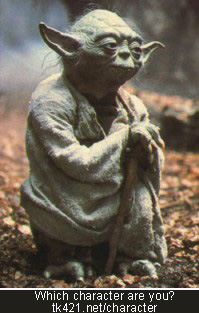
Which Fantasy/SciFi Character Are You?


This is one that I know I've taken before, but I was aware of feeling differently about a few of the questions this time around. So, Yoda. Hmm... I'd better re-translate all that.

"This one taken before I have, but this time of different feelings aware was I."

And lately I've been too tired to come up with much of substance to post. I'd like to post on some of the philosophy of knowledge discussions... It's just that I don't have time when they're fresh in my mind, and then I forget about it. *sighs*

AM ADDENDUM: I just tracked down my earlier result. I had vaguely remembered that I wound up with a LotR character. Turns out it was Aragorn. I'd rather be Yoda.

Inquire Further

11 October 2008

Snow!

The first snow of the year hit the ground this morning sometime before I got up. There was more than two inches on my car, but some of that had blown off the roof. I'd estimate about an inch or an inch and a half everywhere else. But tonight it's snowing again! YAY!

Incidentally, roughly a week ago I was wishing it would snow, and now it is! Clearly I must have caused this snow. `/^

Snow snow snow snow sno-ow!

Oh, the roads this morning were just fine. The snow hadn't hit much of anything north of us, so, apart from the wind, the drive to taiji class was uneventful. But I had to play Jalan Jalan's Bali album. Despite being inspired by a tropical country, Bali, the music captures that calm in the air that comes when the snow has first fallen. Travis thought it was good music to sleep to... but I find it both relaxing and invigorating, so I have no problem driving with it playing.

Inquire Further

10 October 2008

Humian Linkage

Of all the western philosophers I've read, Hume has to be my favorite. I think it's his Dickensian sentence structure, as well as the fact that I can readily follow his arguments. I'm not a big fan of ideas so abstruse (or poorly translated, as the case may be) that I have to read through them a dozen times to get even the faintest glimmer of what the writer is trying to say. Trying to decipher Kant's attempt to get around Hume's cause and effect problem, for instance, is a bit like hitting yourself over the head with a silver-plated zinc bar wrapped in a grapefruit wedge.

Anyway, before I get rambling too badly (as I have a tendency to do after reading anything with Dickensian sentence structure; it's strangely infectious; particularly the odd, comma placement), here are some good links for Hume:

Wikipedia's article on Hume

Stanford Encyclopedia of Philosophy: David Hume

Online Library's list of online Humian texts

Enquiries Concerning the Human Understanding and Concerning the Principles of Morals. We read an excerpt from this in my Philosophy of Knowledge class. It starts on page 15 of the link.

Inquire Further

08 October 2008

Random Trivia

It is possible to get a full-size bicycle into the back seat of a Toyota Echo if you take the front tire off and slide the forked piece that holds said tire under one of the front seats. I'm sure that piece has a name (front axle, maybe?), but I went for descriptive since I wasn't sure what the name was.

Inquire Further

06 October 2008

Bertrand Russell

This quote showed up on Pharyngula's random quote generator, and I just had to steal it:

What makes a free thinker is not his beliefs, but the way in which he holds them. If he holds them because his elders told him they were true when he was young, or if he holds them because if he did not he would be unhappy, his thought is not free; but if he holds them because, after careful though, he finds a balance of evidence in their favor, then his thought is free, however odd his conclusions may seem.

Bertrand Russell, "The Value of Free Thought: How to Become a Truth-Seeker and Break the Chains of Mental Slavery" (1944) in Bertrand Russell on God and Religion (Buffalo, NY: Prometheus, 1986), pp. 239-40


I've only read a little bit of Russell (many of his texts can be found here), but I've rather liked what I have read. I have read his essay, Why I Am Not a Christian. It's a fairly methodical (and short) look at the common justifications for belief. My impression is that he's not trying to convince anyone so much as just listing his own reasons not to believe. Worth reading.

And while I'm posting semi-random quotes, there's a good one from Hume at Evolving Thoughts today.

Edit: added missing 'L's to "Russell". ^/^

Inquire Further

05 October 2008

Making Money, Pratchett Style

Terry Pratchett's latest book just came out in paperback, and I just finished reading it, roughly 28 hours after buying it. It would have taken less time, but I was working on a take-home test for Theory of Knowledge.

It's a very good read. I don't like it quite as well as Going Postal or Night Watch. It feels ... fluffier, I suppose. Still enormously entertaining, however. Moist von Lipwig is back, and with the post office now running efficiently, he's bored out of his skull. He's taken to picking the locks on and breaking into his own building to relieve the boredom. Naturally, Vetinari knows all about this and has ... plans ... for Lipwig. The bank system is in need of an overhaul, and who better to fix a bank than someone who used to rob banks?

Just to give the overall flavor without spoiling anything: the Lavishes are every shiftless, greedy family on every soap opera, and one of them is having an identity crisis; Mr. Fusspot, the new chairman of the bank, has his paw on the pulse of, er, well, better not to ask what; the department of Definitely-Not-Necromancy has some translating to do; Mr. Bent isn't; things that go Gloop in the night Gloop; and some golems have a penchant for gold.

Recommended to anyone who likes a good laugh.

Inquire Further

The Void?

I'm basing this title on the notion of "The Void" in Robert Jordan's Wheel of Time. For those not familiar with it, the idea is to "light" a small flame in the mind and use it to burn away superfluous thought and emotion, leaving only pure awareness behind. It's an idea I've played with off an on since starting to read the series, but yesterday I think I finally experienced it, or something similar enough to it that I feel the name fits.

It wasn't a completely new experience. It was a feeling of being awake and aware, and fully here. I've had this several times before, but I had no idea how to get there on my own. I would be in that state or I wouldn't. If I wasn't there, I didn't know how to get there. If I was there, I wanted to hold onto the state of mind but didn't know how. Yesterday, I found myself in that state, and found I could put myself in and out of it nearly at will. To explain how, I'm going to have to talk about chakras:


They are usually presented as literal energy centers in the body. I will say that I feel a concentration of energy in those centers, but what I can't say is whether I would feel that if I hadn't been exposed to the idea of chakras. I do know that I have always experienced physical sensations in the heart chakra (center of the chest) in connection with strong emotions: cold and blue for sadness; a raw lump of flesh when I was mourning my grandmother, etc. Whether that's something physical or a mere mental artifact ... *shrugs* I find them useful as a way of taking stock of myself each day.

The picture is a classical representation of where these centers are supposed to be. It's been part of my breathing-meditation for the past 648 days to mentally visit each center and "open" it: imagine the color for it flaring around it in a disc of light. I started this practice after reading Your Aura and Your Chakras. It's written in a down to earth style that, while credulous, can easily be read as a useful series of visualizations. I wrote about it once before on my nearly defunct blog. The interesting thing was that the author adds an eighth chakra, which she refers to as the "golden sun". We often use that visualization in taiji exercises: a source of golden yang energy about a foot above the head.

My general practice is to start with the root chakra (at the bottom of the diagram, red) and work my way up to the crown chakra (violet, just above the head). Then I started adding in the "golden sun" chakra, above that. Then I would work my way back down, "closing" each chakra back into a single "gem". Then, one day, just out of curiosity, I mentally explored the region even further above the golden sun, and found myself thinking of it as the moon or the void. It seemed... black and empty, but empty in the sense of pure potentiality. It somehow felt like it was everywhere and everything at once. I immediately associated it with Jordan's Void, but it didn't seem particularly useful at the time I first encountered it. Still, it seemed to be a ninth chakra, so I played around with it on days when I had time for it.

Then yesterday in taiji, I found myself bringing my mind into that empty ninth wheel, and something clicked inside me. I sat up straighter. I looked around me and every detail seemed crystal clear. It was like flipping a switch and finding myself in that state of clarity and wakefulness that before had simply come and gone without any intervention on my part. I brought my mind down out of the void, and the world around me faded. Colors weren't as bright; my focus went fuzzy. I brought it back up into the void and was back in that state of clear wakefulness. I didn't know if this would last, if I would maintain the ability to move in and out of that state, but it's lasted one day at least. I can still put myself into that mental state. It's...fascinating. It's also easier to get things done. It's like... when I sink back down, there are conflicting impulses, multiple wave-functions of myself fighting to coexist. In the Void, those pulses unite into One.

It would be interesting to know if a brainscan would be able to detect the difference between those states, and what that difference might be.

Disclaimers: I'm not making any metaphysical claims for this state of mind. I'm just describing my experience with it. And if anyone feels like trying the meditation I've outlined, don't be disappointed if you don't get results right away, or don't get the same results I did. Meditation is a very subjective thing. Visualizations that one person finds incredibly helpful may do nothing for the next. The flame/void visualization never did much for me, but I still think that this Void is very similar in nature to the one Jordan described.

I should probably mention that in Hindu thought, as you go up the chakras, you are getting closer to the point of origin. Climbing up out of the body's gravity well, as it were. After meditating on the chakras, I can see where they got this idea. The experience feels somewhat like climbing out of the body. Thinking of it that way, though, seems likely to lead to trouble, imo. I prefer to think of it simply as visualizations that lead the mind into a particular state. It's equally important to know how to get out of that state: for this method, that is simply to climb back down the ladder, closing the chakras on the way.

Inquire Further

03 October 2008

Rendezvous

During the spring semester, ISU's new behemoth of a building officially opened for business. It was built because ISU had a grant coming that could only be used to build something, and if they didn't build something, they would lose the grant. Now, the sensible thing would have been to acknowledge that ISU didn't actually need a new building, but apparently This Is Not Done. So we have a rather schizophrenically purposed thing taking up space where a lovely grassy area once was. The little remaining grass is apparently scheduled for future parking lot duty.

While I think its construction was largely pointless, I do like the building's aesthetics. Mostly. It's a nice mix of avant garde lines with modern industrial touches. From a purely aesthetic viewpoint, the public areas are magnificent. Lots of open space and natural light, color (which the physical science building is sadly lacking), and industrial touches (visible support columns; stair railings that look like industry mesh; etc.). I particularly like the feel of the food cour area. It's like you're outside walking between two highrises. Nicely done. From a functional standpoint, however, there are some big problems.

The stairs are my biggest pet peeve. There are two easily accessed staircases that go clear up and down the classroom side of the building. They are, however, open staircases, with the aforementioned mesh. I have a minor fear of heights and absolutely hate going up them. For some odd reason, I don't mind going down them, but going up bothers me. There are alternative staircases. These are not easy to find and were obviously not intended for daily use, as they lack even the slightest hint of the style of the rest of the building, not to mention that they stink. Of what, I'm not sure. Last semester, I thought it was paint, but surely that would have cleared up by now. Final option: there is one, very small, elevator.

The classrooms are my next pet peeve. All of the hallways and public areas are rife with windows and natural light. The classrooms are dank little boxes. Sure, they've got the most modern equipment, and projectors, and so on, but there are no windows in any of the classrooms I've been in. I walked by one that seemed to have a window, but that's an exception. Most of them are on inside walls, where a window would be impossible. The numbering system is also rather haphazard, but no more so than physical science. I haven't made up my mind about the tables most rooms have in place of desks. I see some advantages and some disadvantages, so overall I'm indifferent.

To sum up: the Rendezvous is a pointless building designed primarily for aesthetic appeal, with functionality thrown in as an afterthought.

Inquire Further

01 October 2008

I am the Number 31!

Well, no, not really... I just got " hào" and " suì" mixed up when we were practicing in class. We were discussing ages. I said, " Wǒ jīnnián shì sān shí yī hào.", which more or less translates as, "Today I am the 31st" or the number 31. " hào" designates numbers in a series. What I should have said was, " Wǒ jīnnián shì sān shí yī suì.": "Today I am 31 years old." Still, if I have to be a number, 31 isn't a bad choice. At least it's prime! ^/^

Inquire Further

30 September 2008

Secrets in Song

On the S3 teaser for Dexter, they used a song that I fell in love with on the first hearing. It has the feel of an old classic. I could imagine it coming from sometime between the '20s and '40s. But, no, it's actually pretty new. This video kept the retro-pastiche feel of the song by using black and white stills. I think it may be a video made by the artists themselves, but I'm not completely certain. I'm not sure I like the talking segment in the middle of the full song, but I've certainly encountered period songs that do something similar. Full lyrics here, and the singers are the Pierces.

I like the chorus enough to post it here:

got a secret, can you keep it?
swear this one you'll save.
better lock it in your pocket,
taking this one to the grave.
if i show you, then i know you
won't tell what i said.
because two can keep a secret
if one of them is dead.


I love the rich, deep red tones of the melody, and the crisp pronunciation of all the words. Beautifully done. (Full album here, with previews of the other songs. First impression? I like about half of them)

Inquire Further

28 September 2008

Dexter, Season 2

I finished watching this a while ago, actually, and just finished a second viewing today. It is more intense than the first season. In the very first episode, a team of divers looking for a sunken ship stumbles across Dexter's dumping ground, and the majority of the season is spent on the hunt for the "Bay Harbor Butcher." Dexter really hates that name, btw. He's also going through a bit of an identity crisis, partly due to what he had to do at the end of Season 1, and partly due to unpleasant things he keeps learning about his father. If you want mega spoilers and episode summaries, go here.

For a taste of the show, here's a teaser promo for Season 3; here's a cast interview with recaps of season one and hints at season two; and here's an actual Season 3 Promo.

I'll put a spoilerish discussion of my own below the fold:


A theme that has always fascinated me is one of hidden identity. Earlier, I posted on a pivotal moment, where Dexter can no longer hide from one particular character. I still consider that the best scene of the season. But the theme goes deeper than that.

As part of a cover story, Dexter winds up admitting to Rita that he has an addiction. In the context of the discussion, she assumes this means heroin, and insists that he join N.A. He waffles on his reaction to the program, but eventually thinks that he has a sponsor who can understand and help him (whether the sponsor knows the exact nature of his addiction or not). In some sense, it seems to be working...except that now Dexter finds his personal life falling apart. After re-watching the season, I would argue that Dexter wound up substituting one addiction for another, and the new addiction was much more harmful to him and the people around him ... particularly when the person to whom he became addicted didn't want to let him go.

Later, Dexter talks about the weight of the mask, and what a relief it would be to finally let it go. This would mean turning himself in as the Bay Harbor Butcher, being put in prison, and probably executed, but to be rid of all the secrets seems, for a time, worth it. He's also not sure whether it would be more selfish to keep hiding, and force someone else to pay the price for his crimes, or to turn himself in and rip apart the lives of Rita and his sister. In the end, the decision is taken from him.

The interesting thing is that Dexter sometimes acts as if he really believes that the 'monster', the 'Butcher', is his only real self, yet he acts automatically to protect people and things that only his 'mask' would care about. Wear a mask long enough, and it starts to seep through the skin. Which one is the 'real' Dexter? They both are. He may be very good at compartmentalizing, but he'll never be completely free of either of his selves, and they're never completely separate. While the monster plays, the mask keeps watch and makes sure that no incriminating evidence gets left behind. While the mask interacts with society, the monster keeps watch on those the mask cares about.

Inquire Further

27 September 2008

Unintentionally Cannibalistic

Nǐhǎo!

A few amusing gaffes in Chinese this week. We were discussing food, which is " fàn ". So to describe a particular country's food, it should be "[countryname]fàn". On the other hand, to describe a nationality, it should be "[countryname]rén. So, when you're describing what you like to eat, it's important not to confuse the two. ^/^

We had at least two people make the mistake. The one that I remember was, " Wǒ xǐnghuan chī Fǎguórén". Literally, "I like to eat French people." It should have been " Wǒ xǐnghuan chī Fǎguófàn": "I like to eat French food".

Oh, and I found a site that will convert words into the correct html pinyin if I type the word in and tell it the tone. It required adding three lines of code to the blogger style sheet, which isn't bad at all. At some point, I'll have to figure out how to get actual Chinese characters to display without converting them into picture files, but this is much better than trying to brute-force the tones in.

Zàijiàn!

Inquire Further

25 September 2008

Ironically Susan

Your result for The Which Discworld Character Am I Test ...

Susan Sto Helit

You scored 92 intelligence, 63 morality, and 42 physical strengenth!

As Death's granddaughter (a long story, which you greatly dislike), you inherited his ultimate practicality and lack of fear. In fact, boogeymen and other childhood boggles fear YOU. Often assisted by the Death of Rats and his raven, you manage to fix the Universe inbetween working as a governness and educating the masses. The ultimate teacher.


Take The Which Discworld Character Am I Test

Why ironically? Because my first thought was "Sigh, of course. I'm Susan." Which is exactly how Susan would (likely) react. ^/^

H/T: Evolving Thoughts

Inquire Further

22 September 2008

Chinese Test 1

Ulgh. The phrase "my brain hurts" comes to mind... But the few characters that I couldn't remember I eventually figured out via context. There was one place where we were supposed to rearrange the characters into a coherent sentence. Well, several places, but one place where I couldn't come up with anything that satisfied me. What I finally put down would translate as "My younger brother and your younger sister are what?" It would make sense to me with "who" instead of what, or if there where a 'zuo' in there, making it a question of what they "do" (as in job), but if the characters were all there as given, then I'm just confused.

Still, I'm reasonably certain I passed it. Hang on... Okay, just making sure I hadn't gotten 'zuo's character mixed up with 'dou's. Anyway... I'm thinking that next time I'll take it on Tuesday and skip out on an office hour, as I was a bit wired from the test when I got ready to teach my stats class.

Oh, I showed my flash card set to one of the guy's in Theory of Knowledge. I used most of the cards from the set of 80, and put a single character on each one. So, at least 70 distinct characters. He was asking how many characters there were. Answer: thousands upon thousands. Then I held up the bundle of cards: "And these are the ones we've seen so far." Most of them, anyway. I left off some of the plain radicals that we haven't used as vocab yet. ^/^

UPDATE: I'm not the only one who struggled with that particular derangement of characters. A student who is only taking 101 again because 102 got cancelled thought there must be a missing word as well. And I strongly suspect it was "zuo", so that we were supposed to construct a sentence asking what the little brother and sister do. Bao Laoshi said he would look at it and see if he had, in fact, left something out.

Inquire Further