


Happy Solstice

Despite Pocatello having flash flood warnings and record amounts of rain (more than 3 inches so far in June; normal is about 1 inch), the first day of summer is upon us. Click on the picture to see APOD's blurb about it.

Despite Pocatello having flash flood warnings and record amounts of rain (more than 3 inches so far in June; normal is about 1 inch), the first day of summer is upon us. Click on the picture to see APOD's blurb about it.

Just had to point this one out. Click on the picture to go to the APOD page for the image (where you can see a much bigger and even more impressive version, as well as info about the picture).
I wanted to post a picture of the snow on my wreath from yesterday. There was enough blowing to plaster bits of snow 8 or more feet up on the house. On every side. On the plus side, this made the wreath very pretty... but I've once again left the camera at my mom's house. So I'll share APOD's pic from Christmas instead: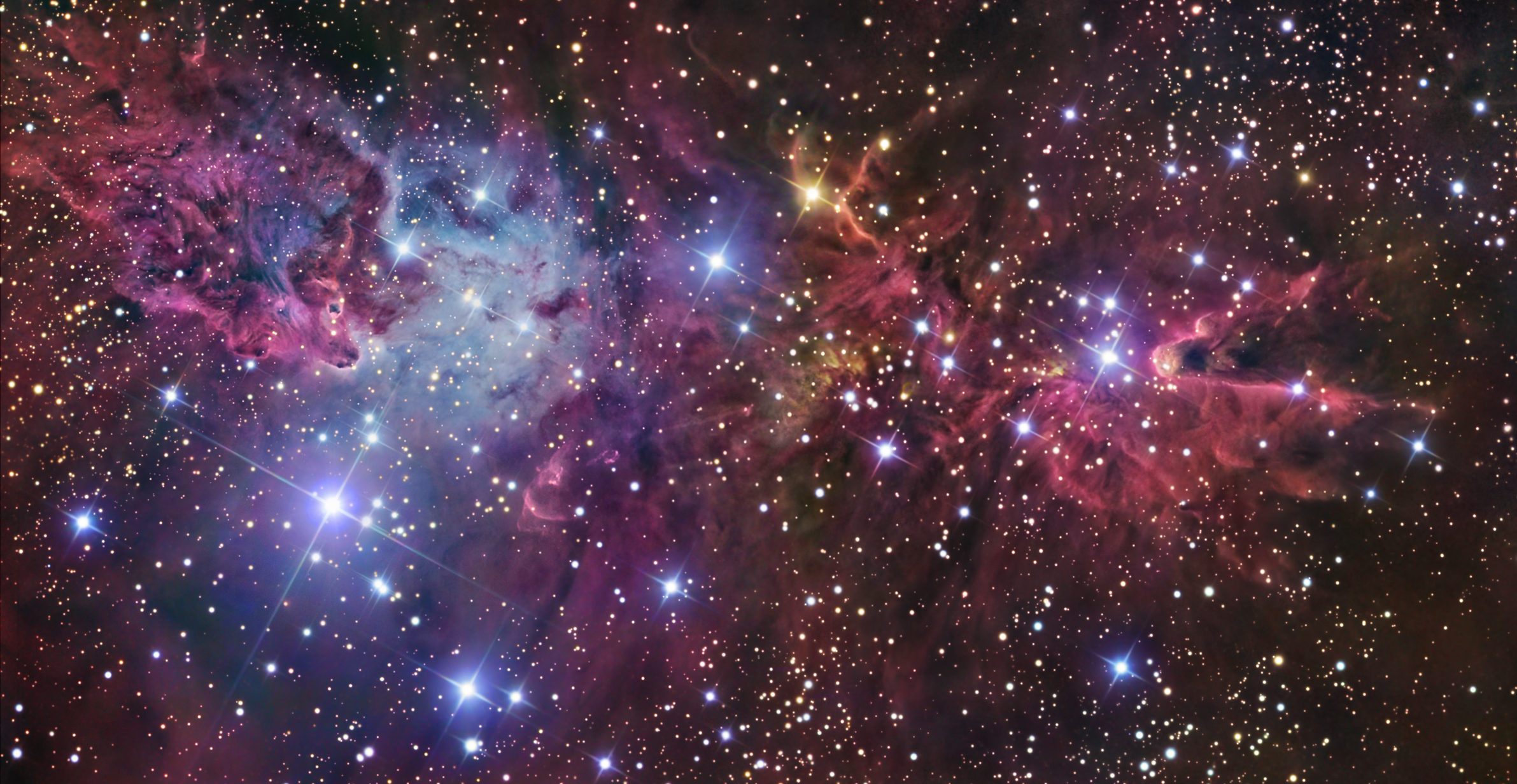
Those are some nice holiday lights!
~Folk Etymology (Google Books)
This morning, for half a second, I thought there were two suns in the sky. There is a genuine astronomical phenomenon where there appears to be more than one sun, but, alas, that wasn't it. Instead, the sun was at exactly the same height on the horizon as a row of windows on a building, and I was seeing the reflection.
The astronomical version is referred to as "sun dogs" or, more formally, as "parhelia". It has the same cause as solar and lunar halos: ice crystals high up in the sky that refract the light. From Wikipedia:Sundogs typically, but not exclusively, appear when the sun is low, e.g. at sunrise and sunset, and the atmosphere is filled with ice crystal forming cirrus clouds, but diamond dust and ice fog can also produce them. They are often bright white patches of light looking much like the sun or a comet, and occasionally are confused with those phenomena. Sometimes they exhibit a spectrum of colours, ranging from red closest to the sun to a pale bluish tail stretching away from the sun.[1] White sundogs are caused by light reflected off of atmospheric ice crystals, while coloured sundogs are caused by light refracted through them. White sundogs are also thought to be caused by the light from the sun reflecting off of water on the ground and focusing the reflected light on the clouds above.
Here is a more concise discussion of the physics involved; and here is one with a few more diagrams and examples. If the ice crystals are randomly distributed, you wind up with a halo, but if they are all "oriented with their flat faces horizontal", then you wind up with sun dogs instead. Wikipedia mentions that the size of the ice crystals may also influence the end result.
I first read about these in sixth grade when I was on an extreme astronomy kick, and I found it a very strange idea. Synchronistically, that year I actually saw some sun dogs. It was the last year that Mom and I took the train out to Colorado. I was wandering through a car with glass walls and ceiling (probably the dining car, but I can't remember for sure), and looked up at the sky as we were going through the mountains in Colorado. There seemed to be 3 suns in the sky. I might have been very confused if I hadn't gone on an astronomy reading spree the summer before!
One point is confusing me, though. The books I read said that 2 extra suns was the norm, but that there could potentially be 4 or 8, while everything I'm finding on the web only mentions 2 ... except Wikipedia's discussion of sun dogs on other planets. Okay, some of the pictures (page down) show a third sun at the peak of the halo, and there would likely be one at the bottom as well, but that part of the halo is below the horizon. So... if there were eight, either they'd have to be at the midpoints in between, or possibly on a second halo. And as double halos are possible, that seems plausible. Incidentally, that photo came from a site full of awesome pictures.
ADDENDUM: I got curious as to the origin of the phrase "sun dog" and went hunting. There doesn't seem to be a clear consensus, but this explanation seems plausible:Sun-dog, the phenomena of false suns which sometimes attend or dog the true when seen through a mist (parheliong). In Norfolk a sun-dog is a light spot near the sun, and water- dogs are light watery clouds ; dog here is no doubt the same word as dag, dew or mist, as "a little dag of rain " (PUlolog. Soc. Trans. 1865, p. 80). Cf. Icel. "';/, Dan. and Swed. ilug, = Eng. "dew." In Cornwall the fragment of a rainbow formed on a rain- cloud just above the horizon is called a weather-dog (K. Hunt, Romances and Drulls of West of England, vol. ii. p. 242).

