19 October 2008

Craving...Muffins?

I've had cravings for lots of things, but usually they're things that make some sort of sense. Chocolate, for the stimulant. Salt, likely when my levels are a bit low. Various vegetables, presumably due to being low in some nutrient. But...what does it mean that I was craving muffins tonight? I suppose it could be for the carbs, but I've been getting plenty of carbs lately. Too many, arguably. So, I don't get it.

But I did make muffins. Since I'd just discovered that Fred Meyer had coconut flour and bought some, I decided I might as well try finding a muffin recipe that used it. I made a variation on this recipe, the blueberry muffin one, but I doubled it and reduced the honey slightly. I'm glad I did. The coconut flour is pretty sweet on its own.

They're not bad. Due to the large quantity of liquid and the thickness of the coconut flour, however, they seem to need extra cooking time, at least at this altitude (approx. 4500'), despite using a bit more of the coconut flour than the recipe called for. After eating two of them, I put the rest back in the still-warm oven. Hopefully that will be enough to get them completely cooked. I don't really like spongy muffins.

Anyway, next time I think I'll just try replacing some of the flour mix in my usual blueberry muffin recipe with coconut flour, and probably decrease the sugar a bit. The reason the recipe uses so many eggs is to add protein, as there isn't much in the coconut flour, and to help the muffins stick together. I'd rather add a touch of xanthan gum, and possibly some rice protein powder, and decrease the eggs.

Inquire Further

Kung Fu Panda


Spencer finally climbed out of his World of Warcrack haze (no, that's not a typo), so I got to see him and Kim and the kids for the first time in roughly a year. Okay, there were also mega-family things going on, but the primary culprit was World of Warcrack. So we caught up yesterday, and went to see Kung Fu Panda at the $2 theater. It would have been worth a full price ticket, honestly.

The story will be instantly familiar. Clumsy nobody gets chosen to be the prophesied hero who must save the day. However, this version is unusually well done. The animation is superb, and the characters are a lot of fun. Also, the writers did at least some research, as all of the Fabulous Five represent actual styles of Kung Fu. You can see them in the picture above: Tiger, Crane, Mantis, Snake, and Monkey.

Some of these even show up in taiji. Legendarily, the founder of the original taiji was impressed by the fluidity of a snake who was fighting with a crane. In the Cheng Man-ch'ing form, we have poses called "snake strike", "embrace tiger; return to mountain", "white crane spreads wings", "step back to repel monkey". I can't think of any mantis examples in our form, but that is certainly a classic Kung Fu style.

It was also enjoyable to see the usual martial arts training sequences turned on their head and pelted with dumplings. Use what works, not what you think ought to work! That's a particularly zen/taoist attitude, and there are plenty of other examples throughout the movie. It's rare to see zen or taoism represented so well in a mainstream work. I suspect they got it right primarily because it was intended as a kid's movie, so they weren't trying to get it right. Then there's the secret ingredient, which I can't tell you; you'll just have to go see the movie. (Or you could read to the spoiler section at Useless Tree's review; he also comments on Chinese political reactions)


All pictures from here.

Inquire Further

18 October 2008

GF Tips: Glutino Crackers

I discovered the other day that Glutino now has more than one cracker flavor available. I really like their original crackers: they're about as close as you can come to a gluten-free Ritz cracker. I don't buy them very often because they are ridiculously expensive. For 4 servings of 8 crackers, it costs roughly $5. Yes, they're imported and gluten free, but that's still ridiculous.

Still, when I saw a new flavor available, I decided to try it. The flavor is called "multigrain", but that is extremely misleading. It does not contain any exotic, gluten-free, whole grains. Instead, they put spices into it whose seeds look vaguely like grains. Poppyseeds. Fennel seeds. I hate the taste of fennel. A label of "spiced crackers" or "poppyseed crackers" would be less misleading. As is, they aren't bad enough that I won't finish off the ones in the box, but I have no intention of ever buying them again. The original flavor is much, much better.

I was going to post links to both products, but I haven't found a link for purchasing either one. Interestingly, the multigrain crackers aren't even listed at Glutino's site, so they must be very new indeed.

EDIT: Found the original crackers, here and here. If you've got a local Fred Meyer, though, try there first. Ah, and here are the multigrain ones.

GF Tips Index

Inquire Further

17 October 2008

Quote of the Day

My religion has nothing to do with either “self-power” or “other-power.” It’s beyond them both. My proof is this: While you face me and listen to me say this, if somewhere a sparrow chirps, or a crow caws, or a man or woman says something, or the wind rustles the leaves, though you sit there without any intent to listen, you will hear and distinguish each sound. Because it isn’t your self that’s doing the listening, it isn’t self-power.

On the other hand, it wouldn’t do you any good if you had someone else hear and distinguish the sounds for you. So it isn’t other-power.

~Bankei


If there are sounds, and there are ears to hear them, the sound will be heard by the ears. You don't do anything, except pay attention. And even if you don't pay attention, the ears still hear the sound. Incidentally, this was found whilst wandering around Daily Zen.

Inquire Further

16 October 2008

Political Sense

Not words that I often put together, but there are some posts over at Informed Comment that are well-worth reading. First, an analysis of failed policies, mostly economic, but all with economic consequences. Second, some thoughts about what an Obama presidency might do. With roughly three weeks to go, nothing is certain, but it seems increasingly likely that Obama will win. That last site uses poll numbers and trend lines to simulate outcomes. Currently, Obama wins in 95% of their simulations (see the second graphs from the top on the right and left).

Internet consensus from non-extremists seems to be that McCain lost the final debate. Instapolls immediately afterwards agree.

Btw, if the best response McCain has to suggestions that he's no different than Bush is to proclaim, "I'm not Bush!", that's a clear sign he's on the defensive. Maybe if he could come up with some clear and substantial examples of places where he differs from Bush, he wouldn't sound so desperate. I wonder if there are any...

Inquire Further

15 October 2008

A Brief Note on Sense Data Theory

According to "sense-data" theory, the only things we directly experience are sense-data. Generally these are held to come from extant but unknowable external objects but the sense-data themselves are also, somehow, taken to be objects in and of themselves. So that if I perceive that a rectangular triangle table* appears to have an acute angle, there really is a sense-datum that has that acute angle and that is what I perceive.

Based on a few remarks from Dr. Wahl, it doesn't look like many buy into this any more. Anyone remember trying to draw a table when you were really little? I do. I'd draw a rectangle, because I knew that the table was rectangular and didn't know anything about perspective. This seems to be common across the spectrum of children (with the exception of my cousin Aaron and, likely, other prodigies). It takes practice to learn to draw with perspective, i.e. to draw what we "really see." This indicates that there's something going on besides simply taking in the visual data as is. There's some sort of processing going on.

The more I learn about Theory of Knowledge, the more I think I really need to take a class on cognitive development, or some equivalent. There's a Theory of Mind class sometimes offered that might do it. A lot of these disparate theories we've been looking at don't really hold up with even rudimentary knowledge of how the brain actually works (or appears to work based on sense data gathered through various infernal machines).

*I caught this shortly after publishing, and it was too amusing not to leave evidence of my mistake. We have a new species of philosophical conundrum! Behold the Rectangular Triangle!

Inquire Further

14 October 2008

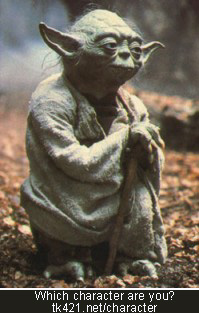
Yoda am I

Which Fantasy/SciFi Character Are You?


This is one that I know I've taken before, but I was aware of feeling differently about a few of the questions this time around. So, Yoda. Hmm... I'd better re-translate all that.

"This one taken before I have, but this time of different feelings aware was I."

And lately I've been too tired to come up with much of substance to post. I'd like to post on some of the philosophy of knowledge discussions... It's just that I don't have time when they're fresh in my mind, and then I forget about it. *sighs*

AM ADDENDUM: I just tracked down my earlier result. I had vaguely remembered that I wound up with a LotR character. Turns out it was Aragorn. I'd rather be Yoda.

Inquire Further

11 October 2008

Snow!

The first snow of the year hit the ground this morning sometime before I got up. There was more than two inches on my car, but some of that had blown off the roof. I'd estimate about an inch or an inch and a half everywhere else. But tonight it's snowing again! YAY!

Incidentally, roughly a week ago I was wishing it would snow, and now it is! Clearly I must have caused this snow. `/^

Snow snow snow snow sno-ow!

Oh, the roads this morning were just fine. The snow hadn't hit much of anything north of us, so, apart from the wind, the drive to taiji class was uneventful. But I had to play Jalan Jalan's Bali album. Despite being inspired by a tropical country, Bali, the music captures that calm in the air that comes when the snow has first fallen. Travis thought it was good music to sleep to... but I find it both relaxing and invigorating, so I have no problem driving with it playing.

Inquire Further

10 October 2008

Humian Linkage

Of all the western philosophers I've read, Hume has to be my favorite. I think it's his Dickensian sentence structure, as well as the fact that I can readily follow his arguments. I'm not a big fan of ideas so abstruse (or poorly translated, as the case may be) that I have to read through them a dozen times to get even the faintest glimmer of what the writer is trying to say. Trying to decipher Kant's attempt to get around Hume's cause and effect problem, for instance, is a bit like hitting yourself over the head with a silver-plated zinc bar wrapped in a grapefruit wedge.

Anyway, before I get rambling too badly (as I have a tendency to do after reading anything with Dickensian sentence structure; it's strangely infectious; particularly the odd, comma placement), here are some good links for Hume:

Wikipedia's article on Hume

Stanford Encyclopedia of Philosophy: David Hume

Online Library's list of online Humian texts

Enquiries Concerning the Human Understanding and Concerning the Principles of Morals. We read an excerpt from this in my Philosophy of Knowledge class. It starts on page 15 of the link.

Inquire Further

08 October 2008

Random Trivia

It is possible to get a full-size bicycle into the back seat of a Toyota Echo if you take the front tire off and slide the forked piece that holds said tire under one of the front seats. I'm sure that piece has a name (front axle, maybe?), but I went for descriptive since I wasn't sure what the name was.

Inquire Further

06 October 2008

Bertrand Russell

This quote showed up on Pharyngula's random quote generator, and I just had to steal it:

What makes a free thinker is not his beliefs, but the way in which he holds them. If he holds them because his elders told him they were true when he was young, or if he holds them because if he did not he would be unhappy, his thought is not free; but if he holds them because, after careful though, he finds a balance of evidence in their favor, then his thought is free, however odd his conclusions may seem.

Bertrand Russell, "The Value of Free Thought: How to Become a Truth-Seeker and Break the Chains of Mental Slavery" (1944) in Bertrand Russell on God and Religion (Buffalo, NY: Prometheus, 1986), pp. 239-40


I've only read a little bit of Russell (many of his texts can be found here), but I've rather liked what I have read. I have read his essay, Why I Am Not a Christian. It's a fairly methodical (and short) look at the common justifications for belief. My impression is that he's not trying to convince anyone so much as just listing his own reasons not to believe. Worth reading.

And while I'm posting semi-random quotes, there's a good one from Hume at Evolving Thoughts today.

Edit: added missing 'L's to "Russell". ^/^

Inquire Further

05 October 2008

Making Money, Pratchett Style

Terry Pratchett's latest book just came out in paperback, and I just finished reading it, roughly 28 hours after buying it. It would have taken less time, but I was working on a take-home test for Theory of Knowledge.

It's a very good read. I don't like it quite as well as Going Postal or Night Watch. It feels ... fluffier, I suppose. Still enormously entertaining, however. Moist von Lipwig is back, and with the post office now running efficiently, he's bored out of his skull. He's taken to picking the locks on and breaking into his own building to relieve the boredom. Naturally, Vetinari knows all about this and has ... plans ... for Lipwig. The bank system is in need of an overhaul, and who better to fix a bank than someone who used to rob banks?

Just to give the overall flavor without spoiling anything: the Lavishes are every shiftless, greedy family on every soap opera, and one of them is having an identity crisis; Mr. Fusspot, the new chairman of the bank, has his paw on the pulse of, er, well, better not to ask what; the department of Definitely-Not-Necromancy has some translating to do; Mr. Bent isn't; things that go Gloop in the night Gloop; and some golems have a penchant for gold.

Recommended to anyone who likes a good laugh.

Inquire Further

The Void?

I'm basing this title on the notion of "The Void" in Robert Jordan's Wheel of Time. For those not familiar with it, the idea is to "light" a small flame in the mind and use it to burn away superfluous thought and emotion, leaving only pure awareness behind. It's an idea I've played with off an on since starting to read the series, but yesterday I think I finally experienced it, or something similar enough to it that I feel the name fits.

It wasn't a completely new experience. It was a feeling of being awake and aware, and fully here. I've had this several times before, but I had no idea how to get there on my own. I would be in that state or I wouldn't. If I wasn't there, I didn't know how to get there. If I was there, I wanted to hold onto the state of mind but didn't know how. Yesterday, I found myself in that state, and found I could put myself in and out of it nearly at will. To explain how, I'm going to have to talk about chakras:


They are usually presented as literal energy centers in the body. I will say that I feel a concentration of energy in those centers, but what I can't say is whether I would feel that if I hadn't been exposed to the idea of chakras. I do know that I have always experienced physical sensations in the heart chakra (center of the chest) in connection with strong emotions: cold and blue for sadness; a raw lump of flesh when I was mourning my grandmother, etc. Whether that's something physical or a mere mental artifact ... *shrugs* I find them useful as a way of taking stock of myself each day.

The picture is a classical representation of where these centers are supposed to be. It's been part of my breathing-meditation for the past 648 days to mentally visit each center and "open" it: imagine the color for it flaring around it in a disc of light. I started this practice after reading Your Aura and Your Chakras. It's written in a down to earth style that, while credulous, can easily be read as a useful series of visualizations. I wrote about it once before on my nearly defunct blog. The interesting thing was that the author adds an eighth chakra, which she refers to as the "golden sun". We often use that visualization in taiji exercises: a source of golden yang energy about a foot above the head.

My general practice is to start with the root chakra (at the bottom of the diagram, red) and work my way up to the crown chakra (violet, just above the head). Then I started adding in the "golden sun" chakra, above that. Then I would work my way back down, "closing" each chakra back into a single "gem". Then, one day, just out of curiosity, I mentally explored the region even further above the golden sun, and found myself thinking of it as the moon or the void. It seemed... black and empty, but empty in the sense of pure potentiality. It somehow felt like it was everywhere and everything at once. I immediately associated it with Jordan's Void, but it didn't seem particularly useful at the time I first encountered it. Still, it seemed to be a ninth chakra, so I played around with it on days when I had time for it.

Then yesterday in taiji, I found myself bringing my mind into that empty ninth wheel, and something clicked inside me. I sat up straighter. I looked around me and every detail seemed crystal clear. It was like flipping a switch and finding myself in that state of clarity and wakefulness that before had simply come and gone without any intervention on my part. I brought my mind down out of the void, and the world around me faded. Colors weren't as bright; my focus went fuzzy. I brought it back up into the void and was back in that state of clear wakefulness. I didn't know if this would last, if I would maintain the ability to move in and out of that state, but it's lasted one day at least. I can still put myself into that mental state. It's...fascinating. It's also easier to get things done. It's like... when I sink back down, there are conflicting impulses, multiple wave-functions of myself fighting to coexist. In the Void, those pulses unite into One.

It would be interesting to know if a brainscan would be able to detect the difference between those states, and what that difference might be.

Disclaimers: I'm not making any metaphysical claims for this state of mind. I'm just describing my experience with it. And if anyone feels like trying the meditation I've outlined, don't be disappointed if you don't get results right away, or don't get the same results I did. Meditation is a very subjective thing. Visualizations that one person finds incredibly helpful may do nothing for the next. The flame/void visualization never did much for me, but I still think that this Void is very similar in nature to the one Jordan described.

I should probably mention that in Hindu thought, as you go up the chakras, you are getting closer to the point of origin. Climbing up out of the body's gravity well, as it were. After meditating on the chakras, I can see where they got this idea. The experience feels somewhat like climbing out of the body. Thinking of it that way, though, seems likely to lead to trouble, imo. I prefer to think of it simply as visualizations that lead the mind into a particular state. It's equally important to know how to get out of that state: for this method, that is simply to climb back down the ladder, closing the chakras on the way.

Inquire Further

03 October 2008

Rendezvous

During the spring semester, ISU's new behemoth of a building officially opened for business. It was built because ISU had a grant coming that could only be used to build something, and if they didn't build something, they would lose the grant. Now, the sensible thing would have been to acknowledge that ISU didn't actually need a new building, but apparently This Is Not Done. So we have a rather schizophrenically purposed thing taking up space where a lovely grassy area once was. The little remaining grass is apparently scheduled for future parking lot duty.

While I think its construction was largely pointless, I do like the building's aesthetics. Mostly. It's a nice mix of avant garde lines with modern industrial touches. From a purely aesthetic viewpoint, the public areas are magnificent. Lots of open space and natural light, color (which the physical science building is sadly lacking), and industrial touches (visible support columns; stair railings that look like industry mesh; etc.). I particularly like the feel of the food cour area. It's like you're outside walking between two highrises. Nicely done. From a functional standpoint, however, there are some big problems.

The stairs are my biggest pet peeve. There are two easily accessed staircases that go clear up and down the classroom side of the building. They are, however, open staircases, with the aforementioned mesh. I have a minor fear of heights and absolutely hate going up them. For some odd reason, I don't mind going down them, but going up bothers me. There are alternative staircases. These are not easy to find and were obviously not intended for daily use, as they lack even the slightest hint of the style of the rest of the building, not to mention that they stink. Of what, I'm not sure. Last semester, I thought it was paint, but surely that would have cleared up by now. Final option: there is one, very small, elevator.

The classrooms are my next pet peeve. All of the hallways and public areas are rife with windows and natural light. The classrooms are dank little boxes. Sure, they've got the most modern equipment, and projectors, and so on, but there are no windows in any of the classrooms I've been in. I walked by one that seemed to have a window, but that's an exception. Most of them are on inside walls, where a window would be impossible. The numbering system is also rather haphazard, but no more so than physical science. I haven't made up my mind about the tables most rooms have in place of desks. I see some advantages and some disadvantages, so overall I'm indifferent.

To sum up: the Rendezvous is a pointless building designed primarily for aesthetic appeal, with functionality thrown in as an afterthought.

Inquire Further

01 October 2008

I am the Number 31!

Well, no, not really... I just got " hào" and " suì" mixed up when we were practicing in class. We were discussing ages. I said, " Wǒ jīnnián shì sān shí yī hào.", which more or less translates as, "Today I am the 31st" or the number 31. " hào" designates numbers in a series. What I should have said was, " Wǒ jīnnián shì sān shí yī suì.": "Today I am 31 years old." Still, if I have to be a number, 31 isn't a bad choice. At least it's prime! ^/^

Inquire Further

30 September 2008

Secrets in Song

On the S3 teaser for Dexter, they used a song that I fell in love with on the first hearing. It has the feel of an old classic. I could imagine it coming from sometime between the '20s and '40s. But, no, it's actually pretty new. This video kept the retro-pastiche feel of the song by using black and white stills. I think it may be a video made by the artists themselves, but I'm not completely certain. I'm not sure I like the talking segment in the middle of the full song, but I've certainly encountered period songs that do something similar. Full lyrics here, and the singers are the Pierces.

I like the chorus enough to post it here:

got a secret, can you keep it?
swear this one you'll save.
better lock it in your pocket,
taking this one to the grave.
if i show you, then i know you
won't tell what i said.
because two can keep a secret
if one of them is dead.


I love the rich, deep red tones of the melody, and the crisp pronunciation of all the words. Beautifully done. (Full album here, with previews of the other songs. First impression? I like about half of them)

Inquire Further

28 September 2008

Dexter, Season 2

I finished watching this a while ago, actually, and just finished a second viewing today. It is more intense than the first season. In the very first episode, a team of divers looking for a sunken ship stumbles across Dexter's dumping ground, and the majority of the season is spent on the hunt for the "Bay Harbor Butcher." Dexter really hates that name, btw. He's also going through a bit of an identity crisis, partly due to what he had to do at the end of Season 1, and partly due to unpleasant things he keeps learning about his father. If you want mega spoilers and episode summaries, go here.

For a taste of the show, here's a teaser promo for Season 3; here's a cast interview with recaps of season one and hints at season two; and here's an actual Season 3 Promo.

I'll put a spoilerish discussion of my own below the fold:


A theme that has always fascinated me is one of hidden identity. Earlier, I posted on a pivotal moment, where Dexter can no longer hide from one particular character. I still consider that the best scene of the season. But the theme goes deeper than that.

As part of a cover story, Dexter winds up admitting to Rita that he has an addiction. In the context of the discussion, she assumes this means heroin, and insists that he join N.A. He waffles on his reaction to the program, but eventually thinks that he has a sponsor who can understand and help him (whether the sponsor knows the exact nature of his addiction or not). In some sense, it seems to be working...except that now Dexter finds his personal life falling apart. After re-watching the season, I would argue that Dexter wound up substituting one addiction for another, and the new addiction was much more harmful to him and the people around him ... particularly when the person to whom he became addicted didn't want to let him go.

Later, Dexter talks about the weight of the mask, and what a relief it would be to finally let it go. This would mean turning himself in as the Bay Harbor Butcher, being put in prison, and probably executed, but to be rid of all the secrets seems, for a time, worth it. He's also not sure whether it would be more selfish to keep hiding, and force someone else to pay the price for his crimes, or to turn himself in and rip apart the lives of Rita and his sister. In the end, the decision is taken from him.

The interesting thing is that Dexter sometimes acts as if he really believes that the 'monster', the 'Butcher', is his only real self, yet he acts automatically to protect people and things that only his 'mask' would care about. Wear a mask long enough, and it starts to seep through the skin. Which one is the 'real' Dexter? They both are. He may be very good at compartmentalizing, but he'll never be completely free of either of his selves, and they're never completely separate. While the monster plays, the mask keeps watch and makes sure that no incriminating evidence gets left behind. While the mask interacts with society, the monster keeps watch on those the mask cares about.

Inquire Further

27 September 2008

Unintentionally Cannibalistic

Nǐhǎo!

A few amusing gaffes in Chinese this week. We were discussing food, which is " fàn ". So to describe a particular country's food, it should be "[countryname]fàn". On the other hand, to describe a nationality, it should be "[countryname]rén. So, when you're describing what you like to eat, it's important not to confuse the two. ^/^

We had at least two people make the mistake. The one that I remember was, " Wǒ xǐnghuan chī Fǎguórén". Literally, "I like to eat French people." It should have been " Wǒ xǐnghuan chī Fǎguófàn": "I like to eat French food".

Oh, and I found a site that will convert words into the correct html pinyin if I type the word in and tell it the tone. It required adding three lines of code to the blogger style sheet, which isn't bad at all. At some point, I'll have to figure out how to get actual Chinese characters to display without converting them into picture files, but this is much better than trying to brute-force the tones in.

Zàijiàn!

Inquire Further

25 September 2008

Ironically Susan

Your result for The Which Discworld Character Am I Test ...

Susan Sto Helit

You scored 92 intelligence, 63 morality, and 42 physical strengenth!

As Death's granddaughter (a long story, which you greatly dislike), you inherited his ultimate practicality and lack of fear. In fact, boogeymen and other childhood boggles fear YOU. Often assisted by the Death of Rats and his raven, you manage to fix the Universe inbetween working as a governness and educating the masses. The ultimate teacher.


Take The Which Discworld Character Am I Test

Why ironically? Because my first thought was "Sigh, of course. I'm Susan." Which is exactly how Susan would (likely) react. ^/^

H/T: Evolving Thoughts

Inquire Further

22 September 2008

Chinese Test 1

Ulgh. The phrase "my brain hurts" comes to mind... But the few characters that I couldn't remember I eventually figured out via context. There was one place where we were supposed to rearrange the characters into a coherent sentence. Well, several places, but one place where I couldn't come up with anything that satisfied me. What I finally put down would translate as "My younger brother and your younger sister are what?" It would make sense to me with "who" instead of what, or if there where a 'zuo' in there, making it a question of what they "do" (as in job), but if the characters were all there as given, then I'm just confused.

Still, I'm reasonably certain I passed it. Hang on... Okay, just making sure I hadn't gotten 'zuo's character mixed up with 'dou's. Anyway... I'm thinking that next time I'll take it on Tuesday and skip out on an office hour, as I was a bit wired from the test when I got ready to teach my stats class.

Oh, I showed my flash card set to one of the guy's in Theory of Knowledge. I used most of the cards from the set of 80, and put a single character on each one. So, at least 70 distinct characters. He was asking how many characters there were. Answer: thousands upon thousands. Then I held up the bundle of cards: "And these are the ones we've seen so far." Most of them, anyway. I left off some of the plain radicals that we haven't used as vocab yet. ^/^

UPDATE: I'm not the only one who struggled with that particular derangement of characters. A student who is only taking 101 again because 102 got cancelled thought there must be a missing word as well. And I strongly suspect it was "zuo", so that we were supposed to construct a sentence asking what the little brother and sister do. Bao Laoshi said he would look at it and see if he had, in fact, left something out.

Inquire Further

21 September 2008

Chili

This is the first time I've made chili using ground chicken in place of ground beef. Much better flavor and texture, imo, but ground chicken is quite a bit pricier. I suspect to get ground beef that tasted anywhere near as good would be just as pricey, as it would require extremely choice cuts.

This is also the first time I've put zucchini in chili, and had more peppers than I could actually use from my garden. I did buy one red bell pepper for it. I'm sure I planted at least one red bell pepper, but I don't have any turning red yet. Yellow, purple, and green, yes, but no red. I thought about putting some fresh basil in as well, but I wasn't sure how well the flavor would go with the chili pepper.

Sketch of the recipe: One of each kind of pepper ready in my garden, plus one red bell from the store; roughly half of a medium zucchini, chopped (not quite two cups); one sweet onion; two pounds ground chicken (1.5 might have been better, but they came in one pound packages); lots of chili pepper, my own taco spice mix, some cumin, red pepper, salt, oregano.

Soak beans overnight (or in my case, for roughly 8 hours prior to starting cooking). Boil for two hours. In the meantime, chop everything. Brown and crumble the chicken with the chopped onion and peppers. When mostly done, add taco spices and other seasonings. Add to beans. Add zucchini. Bring to a boil and let simmer for at least an hour, preferably longer.

You can use canned beans but (a) they're more expensive; (b) they add all sorts of bizarre things to them as preservatives.

As I used the last of my taco-spice mix, you can expect me to post my version of it when I dig out my recipe again. ^/^ Again, you can buy taco and chili seasoning packets, which are less expensive if you don't use the separate spices very much, but most of them are made with wheat, presumably because the gluten helps the spices stick.

Inquire Further

20 September 2008

Studying for Chinese

First test is Monday (or Tuesday; we take it in the language lab). What I'm finding is that I have no problem connecting the pinyin to meanings, and I have no trouble connecting the characters to meanings. My problem is connecting the characters to the pinyin. For a few characters that I've written over and over and over (like shi\, meaning "yes" or "to be"), the connections are all there. For others... Well, for others I just made myself a set of flashcards. This is not a normal technique for me, but I wanted something easy to take with me where I could encode everything. I've got characters on one side, and pinyin on the other, with meanings in a corner that I can easily cover with my thumb.

Also, I'm hoping that such a device will encourage me to get working on my leg strength and endurance in standing meditation postures. As in, give me something to distract me from my shrieking legs. When I can relax enough, I can focus on increasing the pain, and then it will be replaced by a very pleasant golden warmth, but I can't always do that, and I can't always maintain it when I do.

*sighs* I should get back to studying. No leg-work with it tonight, though: Don's back on his relax into the postures kick, so I got plenty this morning. Strangely, my legs were complaining less than Don's or Travis's in pushhands. I'm not really sure why, as I've been incredibly lazy about working on leg strength lately. All the walking I've been doing, maybe? *shrugs*

Inquire Further

19 September 2008

Cleeseblog

Via a series of interesting links, I discovered that John Cleese has a blog. It started with Orac, posting a youtube video that I had come across on another of his Scibling's blogs, but Orac linked to a blog of similar podcasts, and that blog linked to the Big Cleese Himself. I was going to recommend a post there, but reading through them, they're all quite entertaining. So, if you like Pythonesque humor, go. Now. Hurry. Before the internet crashes and burns. Or something.

Inquire Further

Descartes

[Bad Joke Warning]:

Why can't you teach philosophy to horses?

Because you can't put Des Cartes before Des horse!


The fast food server asked Descartes, "Do you want fries with that?" Descartes said, "I think not," and vanished in a puff of logic.


Okay, now that those are over with, on to the actual philosopher. We have most of his Meditations in our text. It was quite an interesting read, with some of the same flavor as the readings from Augustus. It also contains an "ontological argument," i.e. an attempt to prove the existence of god starting from known principles.

I've seen various versions of such arguments dissected, but none of the dissections I remembered really seemed to get at the heart of Descartes' argument. There's an almost Platonic assumption in his thinking. Essentially, if you can think of something, then there must be something in the real world that connects to that thought. He mentions that things like unicorns and hippogriphs are mentally "constructed" from other "real" creatures. A painting of something even more fantastic would still use "real" colors. And since Descartes has a conception of an infinite being, there must really be something infinite out in the "real" world. He can also conceive of a necessarily existent being, so one must necessarily exist.

Why this necessarily existent being must be infinite, or have any other property that Descartes wants to attach to his god, isn't made clear in the sections of the Meditations in our book. This site does discuss why he would think that an omnipotent being would be a necessarily existent being:
To illustrate this point Descartes appeals to divine omnipotence. He thinks that we cannot conceive an omnipotent being except as existing. Descartes' illustration presupposes the traditional, medieval understanding of "necessary existence." When speaking of this divine attribute, he sometimes uses the term "existence" simpliciter as shorthand. But in his more careful pronouncements he always insists on the phrase "necessary and eternal existence," which resonates with tradition. Medieval, scholastic philosophers often spoke of God as the sole "necessary being," by which they meant a being who depends only on himself for his existence (a se esse). This is the notion of "aseity" or self-existence. Since such a being does not depend on anything else for its existence, he has neither a beginning nor an end, but is eternal. Returning to the discussion in the First Replies, one can see how omnipotence is linked conceptually to necessary existence in this traditional sense. An omnipotent or all-powerful being does not depend ontologically on anything (for if it did then it would not be omnipotent). It exists by its own power


Okay, so since he can conceive of an omnipotent being, one must exist and have "self-existence." It does not follow that there is no other self-existent being, nor that self-existence requires omnipotence. Even if it did, I've never found the whole 'Platonic Forms' thing remotely convincing, so "conceiving" of something has no connection to its "existence" for me. Also, I'm not convinced that I can conceive of an omnipotent being. I can imagine something very powerful, but not one with no limits whatsoever. And while I have a mental construct of a concept of "infinity," I would not say that I can genuinely imagine infinity.

But if you want more informed opinions on Descartes and ontological arguments, I found two good articles at the Stanford Encyclopedia of Philosophy:
Descartes' Ontological Argument
Ontological Arguments

My impressions are that the author of the first one finds Descartes' argument compelling, but there is still a decent discussion of the criticisms. The second one seems to be written by someone not convinced by any of the arguments, who points out that they all rest on premises that a non-theist would automatically question, and hence not be convincing to a non-theist.


Inquire Further

18 September 2008

Fly-By Post

Greta Christina has posted her own review of Dexter. She analyzes it more deeply than I did, and still manages to avoid any major spoilers.

I don't watch "Dexter" as an exploration of human nature.

I watch it as a truly astonishing narrative exercise.

The exercise: Can you make an audience care about a serial killer? Can you make them root for him? Can you make them sympathize with him, identify with him, want him to do well? Can you even make them sympathize enough with him that they want him to get what he wants... which is to kill people, and keep on killing people?

And the answer, astonishingly, is Yes.


That is probably the most fascinating aspect of the show: that it works as a show.

Inquire Further

17 September 2008

Augustinian Labeling

But, without any delusive representation of images or phantasms, I am most certain that I am, and that I know and delight in this. In respect of these truths, I am not at all afraid of the arguments of the Academicians, who say, What if you are deceived? For if I am deceived, I am. For he who is not, cannot be deceived; and if I am deceived, by this same token I am. And since I am if I am deceived, how am I deceived in believing that I am? for it is certain that I am if I am deceived. Since, therefore, I, the person deceived, should be, even if I were deceived, certainly I am not deceived in this knowledge that I am. And, consequently, neither am I deceived in knowing that I know. For, as I know that I am, so I know this also, that I know. And when I love these two things, I add to them a certain third thing, namely, my love, which is of equal moment. For neither am I deceived in this, that I love, since in those things which I love I am not deceived; though even if these were false, it would still be true that I loved false things. For how could I justly be blamed and prohibited from loving false things, if it were false that I loved them? But, since they are true and real, who doubts that when they are loved, the love of them is itself true and real? Further, as there is no one who does not wish to be happy, so there is no one who does not wish to be. For how can he be happy, if he is nothing?

~Augustine


I rather like this passage, though I also find it incredibly amusing. See, as soon as he is thinking, then he is trapped in the "ego." It's only when he lets go of thought that he simply is. He has shown that 'something exists which is capable of perceiving' and identified it with his sense of self. That is an assumption.

In another work (I'll cite it tomorrow; too lazy to run and grab the book now), he used the argument that if he claims "p or not p", then he knows that that statement is true by its structure. Now, from a basic logic standpoint, I'll agree. But not from a philosophical one. A zen master might assert "both p and not p and neither p nor not p".

For instance, suppose I have an object before me, that appears to be a yellow crayon. Is it the case that either it is a yellow crayon or it isn't? No. The way to demonstrate what the object is, is to make a mark with it, not to name it. If you call it a yellow crayon, it is not. If you do not call it a yellow crayon, it is. How shall you call it?

Now suppose we put a label on it, and claim the object is a yellow crayon. What have we gained? We have put ourselves at a distance from the object. Rather than experience the object as-it-is, we label it and claim we know something about it. It is what it is: no more, no less. To understand it, the label gets in the way. Worse, it gives a false impression of permanence.

Not so long ago, the crayon was a lump of wax, some pigments, maybe some other chemicals, all sitting in separate vats. The wax might have been in petroleum form or in a beehive before that. The pigments? Buried in the ground, maybe, or bound up in a living being. The vats themselves had to be constructed from raw materials, pulled out of the earth. And the earth itself was formed from cosmic dust... All that to make a yellow crayon that may melt into a car seat before ever it is applied to its "purpose."

Inquire Further

15 September 2008

Happy Belated Mid-Autumn Festival

We found out today in Chinese that yesterday was zhong qiu jié (the first two should be high tone, but I can't find a character with a straight line on top of it to use to mark it). Anyway, our TA brought in a poem that he thought went nicely with it, which I found here:

With a cup of wine in my hand, I ask the blue sky.
I don't know what season it would be in the heavens on this night.
I'd like to ride the wind to fly home.
Yet I fear the crystal and jade mansions are much too high and cold for me.
Dancing with my moon-lit shadow,
It does not seem like the human world.
The moon rounds the red mansion Stoops to silk-pad doors,
Shines upon the sleepless Bearing no grudge,
Why does the moon tend to be full when people are apart?
People may have sorrow or joy, be near or far apart,
The moon may be dim or bright, wax or wane,
This has been going on since the beginning of time.
May we all be blessed with longevity Though far apart, we are still able to share the beauty of the moon together.

Inquire Further

14 September 2008

Teaching the Controversy

I've been reading excerpts from Sextus Empiricus for my Theory of Knowledge class (sadly I haven't found an online translation to either link to or read more from link here). Short version: People disagree about things, so there's no point in holding to any particular opinion; always withhold judgment. Apart from the obvious rejoinder of "What about withholding judgment about withholding judgment?", I think this is a good approach to thought experiments, or anything which cannot be tested empirically. At the time that it was formulated, thought-experiments were pretty much the norm. There was little, if any, concept of testability.

The problem with the Pyrrhic ideal of withholding judgment is that some things are decidable, if you accept "consistency with physical evidence" as a minimum criterion. Note that consistency does not mean "able to come up with a ridiculously convoluted explanation to accommodate the physical evidence, so convoluted that the explanation itself is inconsistent with other physical evidence." But if we must "teach the controversy," why not begin with Intelligent Falling? After all, put to the exact same "standards" as, say, evolution, gravity also fails. (HT: Exploring Our Matrix) And, of course, no one would be able to refute these arguments in a court of law.

Meanwhile, there's that pesky theory of parentism that nearly everyone seems to take for granted...


Oh, you mean that just because an alternate explanation exists, however ludicrous, does not mean that we should teach it? Blast. There goes my "Alchemical underpinnings of astrology on a flat earth" course.

[/snark]

Inquire Further

13 September 2008

Emerging

I cannot understand an attitude that postpones any and all fulfillment to some ill-defined point in the future. I cannot comprehend how someone can find comfort at the idea of this ill-defined fulfillment while suffering in the ‘now’. And I find it pathetic that people grasp so much for this unguaranteed future that they lose track of the here and now. Everything that I have could vanish in an instant. Everything. Why would I grasp after the future, knowing that there is no certainty in it?

There was a brief span of time where I “tried on” Christianity again, years after I’d stopped considering myself a Christian. The why doesn’t matter, though I suspect there’s one reader here who might be able to guess at it. It felt like trying to crawl back into a small, dark box after being exposed to the light of day. Seriously. I stopped almost instantly. I couldn’t find anything of value there. When I read Plato’s allegory of the cave, I empathized with the character who escaped and tried to return.

Since that time, I have encountered variants of Christian thought that I would deem worthwhile. They might best be described as “mystical Christianity.” I find myself agreeing with many of their sentiments, yet I cannot see the point in redefining Christian symbols to mean something that few self-identifying Christians would even recognize. I’d rather start fresh, and look at the world itself, rather than try to cram an entire world into a small dank box. Maybe the hope is that, eventually, the box will rupture and allow the light of day to shine on all within.

But the one thing that really bothers me about mainstream Christianity is that there is no real sense of the here and now as having any worth. It’s all about the future. My taiji instructor likes to say “The past is a beggar; the future is a thief.” People throw away their present lives on the hope of some ill-defined better future. It’s one thing to prepare for the future. It’s quite another to fritter away the present. But that’s what I see people doing, and a notion of some divine paradise in the hereafter only encourages them.

So in this moment, contemplate what you have, what you need, what you are. Think about the things you wish you had done and didn’t, and check which of them you could be doing now. Be aware of what the future is likely to hold, and prepare, but be ready for it to change in an instant. Know that everything you have now could be erased in an eyeblink, and the world would go on. Know that no matter how much pain you feel, the world will still be going on as if nothing had happened. When you know that, and live accordingly, then you have something.

Living life on the assumption of a guaranteed future is the most meaningless life I can imagine. In fact, it’s no life at all. Living on the edge between past and future, and really experiencing it, requires letting go of those future expectations. The world may or may not be exactly the same tomorrow as it was today. My life may or may not be the same. If I can be aware of the change and flow with it, then I am really living. All else is illusion.

Inquire Further

Zyrtec

This season, I've determined that my problem allergens are juniper and grass. Before I had the cats, I could get through without antihistamine aid, and I think my hyper-acidity only made the whole thing worse this summer. Zyrtec is the only antihistamine that has actually worked for me, so I'm grateful. That said, quitting it is not much fun.

I have a comparatively mild case of what seems to be allergic dermatitis, primarily in my feet. This seems to be a common response to people going off of zyrtec. In my case, I've had these symptoms off and on from before taking Zyrtec, they've just never been this severe.

The itching started three days after I took the last pill. To test whether it was "Zyrtec withdrawal," I tried taking another Zyrtec. Near-instant relief. Three days later, the itching came again. It's worst when I lie down; I rarely notice it during the day. This time, I've made it almost five days, and I'm hoping not to need another Zyrtec until allergens flare up again. Junipers usually start producing pollen again in October, for instance. Probably if my reactions were as severe as some described at the links above, I would give it a miss, but the itching isn't constant and I've found a few products that provide relief:

*Benadryl Spray. I can't take Benadryl internally, as it mucks up my breathing, but the spray is good for controlling small, severe spots of itchiness. According to the link, taking alternate antihistamines internally also tends to prolong the withdrawal period, though. I'm hoping that external application will not.
*Lotions containing menthol and/or camphor.

Inquire Further

12 September 2008

Dexter, Season 2, Pivotal Moment

I haven't finished all the episodes yet, but one scene in Ep. 9, Resistance is Futile, just blew me away. I put it below the fold since it's a fairly major spoiler. Admittedly, anyone with Showtime who's interested has already seen it, but as far as I know they'll still be showing it on network tv this fall. Which makes me curious as to how they plan to edit it... Lila, well, has no concept of body-shyness. She's not in the pivotal scene, however.

So, in Season 2, they found Dexter's body cache and named him the "Bay Harbor Butcher." In Ep. 8, Doakes found Dexter's trophy case of blood slides, but wasn't in a position to do much about it, having been suspended. So he tracks Dexter down on his own, and finds him attempting to dispose of a body. Yes, it's a tense scene, but there was something about it that just struck me.

Doakes is holding a gun on Dexter. Dexter knows he's been found out, but also knows that no one but Doakes knows about it. And the mask drops. The real Dexter is out in the open. And I seem to be the only fan who could watch that scene over and over again, since I'm not seeing it on YouTube so far. I can't describe it and do it justice.

It occurs to me that I've always had a fondness for the scene where the murderous villain no longer needs to hide, though in this case he's a murderous semi-hero. I like to see the masks drop, see the killer be who and what he really is. I like it when the real essence of the person comes out into the open. Even in a story where the one in the mask was truly the villain, I root for him in that scene, even if I despise him everywhere else. No more hiding. All the secrets laid bare. That, for me, is always the most fulfilling moment in a story, whether it be a movie, a book, or a television show. That's when I know it's about to get really good. ^/^

Ah, it is on YouTube, but as part of a longer clip. The scene I'm describing starts at about 6:30. Er, language and violence warning, and, of course, S2 spoilers.

Inquire Further

11 September 2008

Hope?

Is your life really so pathetic that you have no hope for anything other than Heaven? Does your life -- the actual life that you're living right now -- have so little joy and meaning that you can't imagine any hope without the promise that, when it's finally all over, you'll get to have another, better, permanent life at the end of it?

~Greta Christina


Few things destroy the meaning in this life more quickly than the assumption that it is nothing more than a 'primer' or a 'proving ground' for the next. That's not always why people 'hope' for an afterlife (see Comforting Fictions), but it's quite possibly the worst reason to do so. It means you've given up on this life. Now that is what I'd call 'hopeless,' in the sense that Greta Christina is using the term.


I like the overall sentiment of the post, though below the fold you’ll find out that I’m not a big fan of the idea of ‘hope’. Perhaps I understand it as the Greeks did. Greta has a more, well, hopeful approach to it. One more quote from her below the fold:


Atheism doesn't just offer the regular sort of everyday hope, the hope for achievement and health and happiness and a better world. Atheism offers, as Cindy's friend put it, the hope that we have the power within us to make things better. Not the hope that we might be able to convince some moody, capricious, punitive, easily- ticked- off God to make things better for us if we walk on the eggshells just right. It offers the hope that no such God exists... and therefore we don't have to worry about what he thinks or what he's going to do. And that we therefore don't have to listen to religious leaders and teachers who tell us at every step that we're bad people, that we're powerless to make ourselves better, that all the power we think we have actually belongs to someone else.


My least favorite thing about most religions is that they strip people of their gods-given power and dignity. If reclaiming that constitutes ‘hope,’ then in that sense hope is a positive thing. The problem is that, generally, hope more often leads to futility and inaction than it does to empowerment. That is, when we describe something as a ‘hope,’ we most often mean that it is out of our reach, out of our power to do anything about. There’s nothing we ourselves can do about it. But because we’re attached to this ‘hope,’ we can’t let go and allow events to take their course.

There is a freedom in the understanding that events are going to unfold, whether we like them or not. There is a power in knowing that we can choose to take action, to attempt to affect those events. What does hope add to that except frustration if our attempt fails? Worse, the hope may continue past its sell-by date, long past the time when there was any realistic chance of its fulfillment. Then it truly becomes poison.

On a lighter note, PZ objects to people being overly pedantic. Do I need to mention that I reacted to the question at hand in what he would consider an overly pedantic fashion? Nah, that’s probably obvious from the rest of this post. `/^ Actually, my initial reaction to the question was to wonder what idiot had phrased it that way.

Oh, what was the question? “Do you believe in the Big Bang?” Er, dimension mismatch error much?

Inquire Further

07 September 2008

Chinese (Mandarin)

In some ways, Chinese is much simpler than English. The majority of common words are monosyllabic. There's no verb conjugation. There's no such thing as "spelling" as we tend to think of it. I'm wondering, now, how one deals with tense in the language, if there's no conjugation. My best guess is that there's a "tense marker" rather like the two question markers: ne (nuh) & ma. For the sentences we've played with, you form the sentence exactly as usual, then add 'ne' or 'ma' onto the end to turn it into a question. Presumably there are rules about when you use which one, but we haven't seen those yet.

As I was walking back from class, I found myself wondering why that construction felt familiar. Then I heard it in my head. "This is way to hotel, no?" "You sell souvenirs here, yes?" The construction exists in English, but is used almost exclusively by non-native speakers, probably adapting a common construction from their own language. But in Chinese that seems to be the only way to ask a question. There's no switching of verb order or tense to turn something into a question. Like we'd say "Do you sell souvenirs here?" or a German might use the order, "Sell you souvenirs here?"

It's rather nice to have the class four times a week. I find myself missing it over the weekend, which may be why Japanese goes MT-ThF, so that the longest gap is a two-day one. Comparing notes with Travis (who is practicing for Japanese so he can get back into it next semester) finds that while Japanese doesn't have tones, it does have "voices," with varying levels of formality. Saying something in a different voice may entirely change the construction of the sentence. Apparently in most classes, they teach the most formal voice, as that one is unlikely to offend anyone they may encounter. I'm not sure yet, but I suspect I prefer dealing with tones and simply constructed sentences to dealing with voices that change the sentence construction. ^/^ Oh, Japanese also has multiple writing systems, one of which essentially mirrors Chinese characters. One new writing system is plenty at the moment. `/^

Inquire Further

06 September 2008

Therapy!

Between 'new' episodes of Dexter and a very entertaining taiji session (with a bonus trip to Barnes and Noble), I'm feeling much better. Also, I got to push hands with Travis today, for the first time in my memory, and he's at a good level for me to work with. Soft enough, and skilled enough, to be able to push me out now and then. Okay, I pushed him out a bit more often than he pushed me out, but he's quite good for being out of taiji for several years.

I haven't quite figured out why I find Dexter, a show about a serial killer who targets other serial killers, soothing...

Inquire Further

05 September 2008

Tulips, Blood and Teeth

I planted tulips this afternoon! And daffodils, and crocus, and hyacinth. I found some deep, deep purple tulip bulbs at Fred Meyer, and some yellow ones with red highlights, and some purple hyacinth, bought those, and also planted the bulbs I bought last fall but never planted. Yeah, I know: probably too late for those. But I'll give 'em a chance anyway. The cats liked that I was outside so much, since that meant they got to be outside, too, but they didn't care for the rototiller for some strange reason.

Then at Wal-Mart, I finally found Dexter, Season 2. I thought it was supposed to come out in August, but I've been checking and this was the first time I saw it in a store. At any rate, those discs should keep me occupied for a while.

As for the teeth...

My mom IM'd me last night to tell me she needed help with a dental problem. Based on prior experience, I assumed this meant she needed to be driven someplace for an appointment. After several mutually confounding exchanges, I figured out she wanted me to do something or other to her "flippers" (insertable teeth to cover the gaps in her mouth until she gets the permanents put in). Which was weird, but okay. Turned out that she was having her picture taken this afternoon, and wanted the front-most gap covered, but with the posts in (the metal things that they'll later screw the new teeth onto), the flippers didn't fit any more.

She had me cut the tooth of interest off of the thing, and then we needed to get the excess material off of it. Mom wanted to cut it off with a paring knife. I knew from experience* that was a bad idea, but I remembered that Grandma had a sander down in the store room, and I was pretty sure it was still there. It was. That got all the excess off, then Mom used the paring knife to cut a groove where the post was. Turned out to be futile, as she couldn't find a way to get the tooth to stay in place. I suggested denture glue, but she didn't want to buy a $5.00 tube of it when she'd only use it once. *shrugs*

*Not with teeth of any sort. In college, I didn't have a nutcracker, but I had bought some hazelnuts still in the shell. Opening them with a paring knife sort of worked...until the knife slipped. I still have a scar on my left index finger from it.

Inquire Further

Comforting Fictions

There are few things more insidious than "hope." We think of it as a positive attribute, in the main, but that does not hold up under examination. For every person who allows futile hope to pull them through a rough patch, there are probably ten others who keep pushing on to their detriment.

It's especially insidious in the face of insufficient information. Take notions of the afterlife. Primarily, I think, they are less about comforting people in the face of their own death and more about comforting survivors after a loss. I find myself in the position of inventing a comforting fiction to keep myself from going mad and spending every moment in an almost certainly useless search.

It is extremely unlikely that Jacques is alive. I have checked and rechecked at the pound, called for him throughout my neighborhood, and kept my eyes open on the walk between home and campus. Nothing. If I allow myself to dwell on that near-certainty, I am overcome with guilt for failing to protect him. If I take a step back and allow the slim possibility that he got lost and was taken in by someone else, I can function. Regardless of how unlikely it is, allowing a small irrational part of my mind to accept that fiction keeps me, to a rough approximation, sane. Without a body to bury, it is not an impossible fiction, but it is still nothing more than an invented story.

As for an afterlife, that is an even more elaborate fiction. I find traditional notions of it completely ridiculous and at odds with the supposedly "real world". But their purpose is not to make sense. It is not even so much to comfort. The purpose, I now think, is to allow them to move on. Keep the comforting fiction at the back of the mind so that they can function in their daily lives. Problems come when they forget that it is nothing more than a comforting fiction. I am not claiming that an afterlife is impossible: just that it has exactly as much evidence as I have for thinking that Jacques could still be alive.

*This post was originally title "Futility" until I noticed that my last post on a similar topic was also titled that. Consistency, eh?

Inquire Further

03 September 2008

Strange Warning Labels

DONT POUR THE BOILING WATER INTO THE MERCHANDISE
DISHWASHER SAFE FOR TOPRACK ONLY
NOT RECOMMENDED FOR USE IN MICROWAVE OVEN


From a set of cheap plastic plates I got at Fred Meyer. The bottom two lines are fairly standard, but I've never seen a "no boiling water" warning on tableware before.

Inquire Further

02 September 2008

Dare I call it "Palin-gate"?

There are thousands, if not millions, of more informed people discussing McCain's choice for VP. I just want to add one data point. My mom considers herself a staunch conservative (she is on financial matters; she's quite liberal on social matters, though I think she'd be horrified if I pointed that out to her. NO! NOT THE L-WORD!). She doesn't like Obama, apparently because she's bought into the "not experienced enough" rhetoric. Due to McCain's choice of running mate, she has said that she "might as well stay home."

For a broader view, here's a survey of general reactions. Summary: hardcore democrats and republicans mostly unmoved; independents less likely to vote McCain. And here is a plausible extrapolation as to how the decision was made.

From my perspective, it looks like a publicity stunt cum temper tantrum gone bad. Publicity stunt in the timing and the "Who?!??" reaction it generated. Temper tantrum in that McCain was told he couldn't go with his first choices without alienating "the base." Presumably he went with a woman in hopes of getting disappointed Hillary-fans to vote for him...which means he must not think much of Hillary supporters, since Palin stands for nearly the opposite. At this stage, I can't imagine the choice gaining him more votes than it loses, but stranger things have happened in elections.

Inquire Further

01 September 2008

Bones, Rocks and Stars

I've been interested in this book since seeing it mentioned on Pharyngula, maybe two years back now. I finally ordered a copy about a month ago. In part, it was very very good. Clearly written, engaging style, good information. However, I thought it was too brief in its treatment of technical matters. I would have liked to see a bit more detail, particularly on radiometric dating, calibration thereof, and other doublechecks (such as the magnetic reversals recorded in the ocean floor). Turney sort of handwaves that these exist, but doesn't go into many specifics beyond one single example handpicked for each chapter. The examples are good, but insufficient.

Basically, each chapter focuses on one technique used to date objects or events, goes through one major example of applying the technique, handwaves some generalities, and moves on. I realize that the book is intended for a lay audience, but would putting a few technical details in place of the handwaving really turn anyone off of reading it? Particularly if he clearly put in a Technical Stuff header before each section, to warn people who aren't interested to skip ahead?

So I recommend the book as a bare bones introduction (no pun intended), and as a good read, but not as a stopping point if the topic genuinely interests you. There is a "further reading" list for each chapter. I might work my way through and see which ones are easily available on the topics most in need of shoring up.

Inquire Further

31 August 2008

If you Like Philsophy Textbooks ... Gettin' Caught in the Rain

Amazingly, the rhythm on that scans. Anyhow, my Theory of Knowledge text got left outside for a while on a little side table. Given the past month or so, this was perfectly safe. Unfortunately, I forgot about it when it did start to rain this afternoon. It was not completely drenched, but it was rather bedraggled. On the plus side (sort of), I've had to deal with this sort of thing before. Usually I find the book after it's had a chance to dry out. I'm hoping that since I found this one while it was still damp, it will straighten better.

Technique: (skip this step if it's a book with staples or metallic decoration) Put in the microwave for a bit. Pull out. Put the damaged book on top of a solid book that is larger than it is. Stack a whole bunch of heavy books on top; the heavier the better. I'll check it tomorrow and see if it needs to be "nuked" again. (Why in the name of Colonel Potter's toenails is putting something in a microwave, which excites water molecules and has nothing whatsoever to do with fusion or fission, called "nuking"? Someone please explain this to me.)

Random items, potentially of interest:

I replaced a light fixture yesterday. Most of the light fixtures in the house were plain ol' 2-light boxes with glass covers, which would be fine, except they all seemed to have the same short: One bulb invariably burns out much, much sooner than it should. I've replaced all but one of them now (the last one requires either a longer ladder than I own or for me to climb into the attic; I'm not thrilled about either option). I lucked into a halogen light fixture on clearance for nine bucks at Lowe's for this one. It's got three aim-able lights on it. I haven't decided how well I like it yet, but so long as the bulbs last, it's preferable to its predecessor.

We had a fuller house than usual at taiji yesterday. Melissa's back in town, and Travis has decided to join us...which means we pick him up, since he can't drive (insurance vs. money issues). He's actually only a few blocks from me. But it's good to have a fresh face in there, especially one who's a bit rusty. Don keeps insisting that Melissa and I have very good forms, but I'm sure we'll pick up on stuff we've missed or forgotten as he walks Travis through things.

I finally have tomatoes attempting to turn red. My plants, both this year and last, just wanted to produce more and more vines, and leave the fruit green for a very long time. I looked this up. Apparently it means I put too much fertilizer on the garden. This is a bit puzzling as I have never put any fertilizer on the garden. So I guess my soil is "too good" for tomato plants. According to my dad, if I keep growing corn, it will get worse and require some sort of supplementation. Perhaps the tomatoes will produce more tomato and less vine then.

Lastly, I've taken to walking to campus on MWF mornings. I drive for my evening stuff, but it's actually easier and saves time to walk in the morning. How does it save time, when it takes 35 minutes to walk and maybe 10 to drive? Because I don't have to leave in time to get a decent parking space, nor leave myself extra time in case there isn't one. Instead of leaving by about 7:10 am, I can leave any time before 8:20 am to get to Chinese (which I'm loving, btw). I generally don't get any more done in my office when I get there at parking-time, so that time has been mostly wasted. Now it's spent in a pleasant physical activity.

So I suppose I'll stop rambling now, as I've lost the thread of my own thought process. For anyone not paying attention, the title really only applies to the two paragraphs above the fold.

Inquire Further

27 August 2008

Platonic Issues

Today's discussion clarified a few things for me, though it also gave me a headache. We read an excerpt from The Meno. It's supposed to show that learning must be "remembering" things we already know. To understand this requires knowing a critical assumption made by Plato. Without that assumption, it just looks like a string of leading questions that mean nothing of the kind.

The critical assumption is that one cannot recognize a perfect form from an imperfect one. So the discussion is about an abstract, perfect square, but the visual aid is an imperfect diagram scratched into the sand. Since one cannot possibly abstract to a perfect square from such an imperfect aid, it must be that the imperfect square prompts one to remember the ideal form of a perfect square. Thus all learning is really remembering things forgotten from the world of forms.

Another example (and I can't remember right now if it was in the excerpt from the Phaedo or from the Republic) is of perfect equality. That we never actually observe two things that are perfectly equal or identical, so the notion must have been there already, waiting to be remembered. But it wouldn't take a whole lot to stumble onto that one. I mean, take two things that are almost alike (say off of an assembly line), note the minor differences and think, "Huh. Except for those, these things are alike." It's not too hard a step from there to think that if the minor differences are removed, they would be exactly alike.

But there's a much simpler idea: a thing is identical with itself. Also, think reflections. Especially if someone can't tell that there's a reflective surface and sees something with its reflection, he's going to think that he's seeing two identical things. Of course, Plato has issues with reflections as well... *sighs*

*stops rambling*

Inquire Further

25 August 2008

Back to Classes

ISU's fall semester started today. I've taught two classes, and been to both of the ones I'm taking. Chinese is going to be fun. I like the teacher's style, and the general atmosphere. I've found one bit of pronunciation that's going to give me fits (and we haven't even gotten to tones yet). 'z' in the pinyin (peen-een) transliteration of Mandarin Chinese is pronounced "dz". 'c' is pronounced 'ts' (a very quick, sharp sound: like the end of 'cats'). However, as I've taken German, I can pretty much guarantee that I will try to pronounce 'z' as 'ts', which is what it is in German.

Theory of Knowledge (aka Epistemology) will be interesting. It's supposed to be Dr. Wahl's specialty. There are some things about his lecturing style that bug me, but it sounds like it's due to become a discussion course once we have things to discuss, so that should be better. The text we're using starts with classical sources. I've skimmed through most of the Plato excerpts. One thing puzzles me. Well, one thing in particular. Plato insists that, for instance, a flower is beautiful to the extent that it reflects (or maybe contains) 'Beauty': an external 'form' that is the source of all beauty. So why is 'knowledge' not treated the same way? Why isn't there some abstract 'form' of 'Knowledge' and people only have knowledge to the degree that they reflect this form? I should admit that I haven't read a lot of Plato, so perhaps there are places where this is dealt with, but at the moment it seems inconsistent to me that he tries to define knowledge while he merely points at 'Beauty'.

I should also point out that the whole 'ideal form' bit makes little sense to me, and has less appeal. Particularly in the case of 'Beauty.' If you talk to most people who drive across Wyoming, they'll tell you how awful it is. How boring and dry and...and so on. I, on the other hand, think it's absolutely beautiful. Stunning, sometimes. I love the topography, and the colors, and the way the wind has shaped the rocks. They say "Beauty is in the eye of the beholder." That doesn't leave much room for a universal, unchanging, eternal 'ideal form' of 'Beauty'.

Inquire Further

23 August 2008

Silences

At the moment, I'm the only one coming to Saturday taiji practice. Largely because of this, I think, Don's agreed to teach me the taiji saber form. It's not a Cheng Man-Ch'ing form, but it's interesting. It's also weird that some of the moves feel like I'm remembering them from somewhere else... I have no idea if that actually means anything, but I'd like to think it means I was, say, a samurai or some such in a former life. The katana isn't quite the same as the saber (some pictures and links here), but they're both curved and single-edges, so I'm sure there's at least some overlap in usage.


The house is too quiet. Jacques was(?) the most vocal of all the cats. Best case scenario, someone took him in. It's unlikely that happened the night he went missing, though. It would have been between 10 pm and 4 am. So that entails the assumption that he got himself lost, then got taken in. We checked at the pound yesterday. No luck. When I was driving around through the nearby alleys and streets, I saw a yard with a cat trap, so I started to hope that he'd just gotten himself trapped and impounded.

The thing that I notice is that I'm still functioning. I wasn't really after Grandma died. It was something like automatic pilot at that point. Things needed to be done, and they got done, and I have little memory of how.

I just keep expecting to come home, and find him in the garden or on the porch... *sighs*

Inquire Further

22 August 2008

Ranting

Item 1: I hate meetings where everything that we really need to know is already written down...and we spend two hours going over it anyway.

Item 2: Apparently the Virginia Tech incident has resulted in some odd policy changes regarding doors. All rooms must easily unlock from the inside. So the doors must not only open from the inside, they must unlock. Which seems okay...except that the one on the Math 108 center cannot now be closed and stay locked. If you close it, it unlocks. Thankfully, the other door does not have this unsecurity device on it, as it's a keypad lock. Supposedly the entire physical science building will be getting these unsecurity devices at some point. Hopefully they figure out how to make the things stay locked when necessary by then. Random thought: such doors may violate insurance policies on computer labs...


Item 3: Jacques is missing. He wanted to play Wednesday night, so I went to bed. He never came and meowed at the window to be let in. I haven't seen him since. I have no idea what happened to him. I've driven up and down all the streets around here, checked at the pound and left a picture and phone number. There's not a whole hell of a lot else I can do (except get him microchipped if he ever makes it back, along with all of his sibs and mom). *tries not to punch a hole in the desk*

Inquire Further

19 August 2008

Bugs at Bruneau

I found myself wondering if I would have seen as many bugs up there if there hadn't been a lake at the bottom of the dune. Certainly, there wouldn't have been dragonflies. Either way, they made for some nice pictures:


That plant looks for all the world like a spindly juniper, except I don't think that there are any junipers with pink flowers. Also, I didn't get a rash when I brushed against some that were a bit close around part of the trail at the lake. So... I'll call it a juniper-like-shrub-with-pink-flowers. Rather Quirmish name, innit.


Beautiful dragonfly. Most of the ones up there were huge black ones, maybe with white markings.


I nearly walked right into this guy's web. It was near the lake, built between two tall stems of grass. I didn't see the web until after I was nearly nose to nose with the spider. From behind, he actually looked a lot like the spiderman logo. Unfortunately, I couldn't get the camera to focus on him from that angle.

Inquire Further

17 August 2008

Bruneau Dunes

On Thursday, my mom had an Excel workshop in Twin Falls. I tagged along, because that got me most of the way to Bruneau Dunes State Park, and I've been wanting to go there ever since I heard of it. It's about another hour and a half from Twin to the park. Overall impression: HOT. Admittedly, I was there at the worst possible time of day (10:00 am to 2:00 pm). If I go there again, I think I'll plan on going down in the evening, camping overnight, and then going up the dunes the following morning. Still, it was enjoyable to play on a giant sand dune. This has to be my favorite picture:

Explanation and more pics below the fold.

Those are the impressions left in the sand from my hat. It fell off when I stopped to rest on my way up the dune. ^/^


It's that way! This was when I finally cleared all the shrubs and things around the lake below the dune and could see the main path up to the top. It doesn't look that bad, does it? Probably wouldn't be at, say, 7:00 am.


Here is the view from just below the top. It took me roughly an hour from the previous picture to get to this one. Walking/climbing in that thick sand is rather interesting. It's a lot like walking in deep snow. I already knew that the trick for going down was to act like I was walking down a staircase and dig in my heels at roughly a ninety degree angle. That works beautifully in sand. For walking up, I tried the inverse of that: digging in the toes at a ninety degree angle as if going up a staircase. That does work if you get your toes dug in far enough. Unlike going downhill, gravity doesn't help you out. It's an exhausting way to walk, particularly in full sun.


And here's the view down the other side of the dune. Some interesting features that I might have been interested in exploring...had going down there not necessitated climbing back up.


I fell in love with these little grass-sand-circles. It looks like, when the wind blows, the grass tips contact the sand and make arcs as they go back and forth. There were lots of these where there was grass growing in the sand. Absolutely beautiful. Random fact: the sand where there were plants growing tended to be more solid, harder to dig my feet into, than sand elsewhere. I don't know if that's because there was more water in it, or more of a certain type of sand/soil, or what.


Those are my footsteps coming down the side of the dune, criss-crossed by another set of prints that look hoofed to me. Deer, maybe.


And here we have something that reminds me of crop circles. Clearly aliens have been using these dunes as a landing strip and the government is covering it up. Or, more likely, something about the wind flow and the shape of the dune and landscape results in oddly flowing air currents... `/^

EDIT: For more on treating sand as snow, and the presence of aliens and flamingos, click here. (Lots more pictures!)

RE-EDIT: Another good gallery here.

Inquire Further

15 August 2008

A Blessing


I found this as a card at the Paper Store in Estes Park. After I saw it, I'd hoped to find it as a magnet (also the source for the image), but they only had the card. I love the sentiment expressed in the blessing, and that it works for anyone, regardless of their particular religious leanings (or lack thereof). The magnet's slightly pricey, but if it's as large as the card (5 inches by 5 inches), that's not a huge surprise.

I bought the card while I was there, and put it up on a magnet board anyway. ^/^

EDIT: Erm, that link is for a journal with the blessing pic on the cover, not for a magnet. Which also explains the expense. I didn't read carefully enough. Here it is as a magnet. Smaller, but about the same price I paid for the card.

Inquire Further

Marlene Winell

I'm resisting the temptation to just steal this post. Much of it I could have written myself, though I likely would have been less eloquent. Also, I would not call myself an atheist or a theist, either one. I object to that language as much as I object to traditional language and descriptions of the divine. It's one of those useless "there are two kinds of people" gambits, a false dilemma. Anyway, I resisted the urge to steal the whole post, and just took this one part (with attribution):

There is no religious description of “god” that matches the grandeur of the universe as it is – elusive, ever-changing, impossibly mind-boggling. And this includes us. We are part of the fabric; there is no separation. If this is believing in god, then by all means, a hundred times YES! But I’m still not drawn to the language.

~Marlene Winell

Inquire Further