12 November 2008

Random Weirdness

I'm posting this mostly because I'm amazed that I recognize all but two of the characters. And what I can read doesn't quite translate as given, but whatever the other two characters are, presumably they contain the key to figuring out what it actually means.


From left to right: bú yào wèi nǐ de měi ?? ?? le wǒ

bú is a negation, so "not"; there's another word for don't, but depending on context, bú might be translated as "don't". Usually it's just "not" or "no".

yào means to want or desire, or can indicate future action; I wonder if "bú yào!" would translate as "do not want!" Possibly.

wèi ... well, the meaning I know for it is "for", but Bào Lǎoshī told us it had many other meanings.

nǐ means "you"

de is a possessive particle (think 's in English)

měi means beautiful or is used as the name for American. I don't think that's the usage here, though, as it's not followed by "guo", meaning "country".

The next two characters I don't recognize... le is a grammatical particle, generally indicating completed action. At least, that's how we've used it. It can also imply past tense.

Then wǒ means "I" or "me". There are no cases in Chinese.

So... "No desire for your beautiful (noun?) (verb-completed?) me/I.

If I remembered for sure where I'd put my Chinese dictionary, I'd try to look the other two up, but I think it's time for sleep now. Oh, the picture is from Engrish.com

Hmmm... I wonder if it's supposed to say, "Don't hurt me because I'm beautiful?" Presumably the missing verb, then, would be "hurt", and yào would be used in the sense of "future action", rather than "desire." For the moment, I'm leaving it, but that seems like a reasonable guess.

AM UPDATE: Found the first missing character. 美麗 (If those show up, the second one is the traditional version of the same character; mainland uses simplified, Hong Kong and Taiwan use traditional) It goes along with měi as "méilì ", apparently emphasizing "beautiful". And the second is 伤 shāng , meaning "injure" or "injury". So... "Don't for your beauty hurt me." I wonder if there's an idiom in there... The literal translation doesn't make a whole lot of sense.

Inquire Further

11 November 2008

Veteran's Day

On Veterans Day, we as a nation pause to honor those who have served their country. Problem is the Bush Administration doesn’t want us to know about their sacrifice. From refusing to allow the press to photograph flag-draped coffins of the dead, to covering up the suicides of veterans after they come home, the officials in Washington who lead us to war have done everything they can to hide it’s terrible cost.

...

How can we even begin to honor our veterans, if we don’t even track their sacrifice?

~Juan Cole


Read the whole thing.

Support the troops. Stop treating them as playthings to be sent on pointless missions at the whim of a liar and a madman. Thankfully, that liar and his cronies will be out of office soon.

Inquire Further

Weird Ads


Found here, which was a link from today's APOD. Presumably, what the ad means is that they'll ship you the paperwork about the star being named after you. However, that's not what it says, and I seriously hope they don't try shipping any stars to earth. So far as I know, there aren't any that wouldn't cause massive problems. Then there's the logistics of trying to find a truck big enough to haul them that wouldn't melt from the severe radiation... It's just a bad idea, all around.

Inquire Further

10 November 2008

Gluten Free Tips (3): Coatings for Frying *UPDATED 10 November 2008*

Okay, I've decided to rewrite the intro. Original text is below if anyone cares. I've tried all of these flour mixes on chicken, with the results listed below. I've now tried sorghum flour on fish, and it works beautifully, possibly even better than it works on chicken. I still do not use batters* of any kind, nor do I dip the meat in anything before coating it (though I do generally salt it first).

First, two disclaimers. (1) The only thing I ever bread to cook is chicken, but as of 22.March, I can say that sorghum flour also works well on fish. That's it. I figure that the flours I suggest will work similarly on other meats, but I can't be certain of that. (2) I do not make any fancy batters. The chicken is slightly damp, just enough for the flours to stick, but that's all. If you're into using eggs and milk and crackers, my experience won't be much use.

Below the fold is a list of the types of flours I've tried as coatings with my results. It will probably be expanded at some point(s) if I try other variations.


corn meal: Gives a very good coating. It's just a bit crumbly, but if you're careful this isn't a problem. Also works well mixed with sorghum flour.


corn starch: I never had much luck with it. Bette Hagman recommends putting some in a ziplock bag, putting the meat in, and shaking it to coat, but the coating winds up far thinner than I like.

potato starch mixed with corn meal: Similar to tapioca starch mixed with corn meal, but the potato starch doesn't bubble up as much. Haven't tried potato starch on its own yet. I have two problems with this mix: (1) It's very crumbly and doesn't stay on the chicken very well; (2) It absorbs massive quantities of oil. Tasted okay, but it's not one I really recommend.

potato starch mixed with corn meal and sorghum flour: Basically I took what was left from the above experiment and added an equal volume of sorghum flour. It worked much MUCH better than just the potato starch and corn meal. The potato starch adds a bit of thickening that just corn meal and sorghum flour lack. Still, I prefer corn meal and/or sorghum flour without the potato starch.

rice flour: I've never had much luck here. It sort of works, but it just tends to fall right off. I suspect that if you did make a batter of it, it might work better.

sorghum flour: Gives a nice, thin golden coating that stays on quite well. For a bit more thickness, I often mix it with corn meal.

tapioca flour: Wow. This stuff bubbled and thickened up as if I had made a batter. It wound up extremely thick and rather hard. It actually reminded me of the coating Wrangler used on one of their fish baskets. If you're into really thick coatings, then this is a simple way to get them, but I'd suggest using a pan big enough to leave space around each piece you fry; they tend to cook together. I tried mixing tapioca flour with corn meal and got a less volatile result, but I still prefer corn meal + sorghum flour.

*UPDATE: For those interested in a thicker coating that does use eggs to help it stick, try this recipe. Thanks to Aunt Bee for providing the link!

GF Tips Index

Inquire Further

Monday Art

For no particular reason, I thought it was a good day to post another one of these:


I named it "ducks" and then had to look at the picture for a while to figure out why I'd named it ducks. Incidentally, this is much easier to do with a touchpad than it is with a mouse (and would probably be easier still with an actual pen/stylus pad, if I had one). This one was done using a mouse. I can't get as many tight twists in when using a mouse.

Inquire Further

Scaredy-Dog


At my dad's house yesterday, I decided to grab on old stuffed toy of mine. It looks a lot like the one pictured above (which you can buy at the site the picture links to). Buster seemed curious about it, so I held it where he could see and then, just for fun, made a hissing sound just as he got close. Buster acted much more startled than I would have expected. When he came back to investigate again, I made the tiger hiss and jump again. Buster jumped back and started barking. He was so worried about the "tiger" that he didn't even notice when my dad offered him food. Finally I had to get the tiger out of his sight so that he'd calm down. Then when it was time to go, I pulled the tiger out again to see what he'd do. He hid behind my mom, peering out around her legs to see if the "tiger" was still "watching" him. Silly dog. ^/^

I have to wonder what, exactly, he's crossed with. All we know is he's a "terrier mix". Most of the terriers I've encountered have been fearless, recklessly so. Our first dog, Socks, was probably about 12-18 inches tall (I was small at the time, so I'm estimating). He had no problem confronting a dog two or three times as big as he was. Also a "terrier mix". Apparently whatever Buster was crossed with does not have the terrier bravado. Which is probably better in the long run, as he's less likely to pick a fight he can't win.

Inquire Further

07 November 2008

The Little Things in Life...

At Mind Hacks' weekly roundup I found a link to this article, discussing what it takes for people to become happier over time. The conclusion?

However, improvement may not come from major events such as winning the lottery, despite the seemingly life-changing nature of such examples. Rather it seems like the key for long lasting changes to well-being is to engage in activities that provide small and frequent boosts, which in the long run will lead to improved well-being, one small step at a time.


I find this of particular interest because it handily explains how my decision to engage in a daily practice of taiji and meditation was able to pull me out of the deep depression I found myself in after my grandma died. It gave me a "small boost" each day, and, over time, those boosts resulted in a lasting difference. Time helped, too, of course, but I'm honestly not sure I would have made it through the worst of it without that daily practice. I don't think I would have suicided, but I suspect that I would have gotten to the point of not being able to function. Sure, there are medications out there that might have helped, but I'll take meditation over meds any day.

Inquire Further

Obama's Plans

Obama and his team have put up a web-site detailing what they hope to accomplish. It's change.gov. I have only had a chance to skim it. Based on sheer volume of material listed, his priorities are the economy and foreign relations (both positive and negative aspects thereof). Those lists are so long that I just have to shake my head. The other lists look more reasonable and doable.

Other than that, my first thought was, "Wow. He's actually communicating what he wants to the People." There are some vagaries, but not as many as I expect from a politician. That's one thing that's struck me about Obama from the beginning. He manages to be a politician, who can speak the language of the politician, and still actually manage to say something meaningful. I may not agree with all of his goals (science policy is conspicuously missing from the front page issues), but that alone is impressive.

Either way, take a look if you want to see what Obama hopes to accomplish. (HT: James McGrath)

Inquire Further

Tao Te Ching, character by character

Okay, technically "dao de jing" is more accurate, but more people recognize the text under the old transliteration. Either way, I found a site that links to one version of the Chinese text and every character hyperlinks to its definition. The site is Zhongwen.com and the Dao de Jing is here. Oh, "zhongwen" is usually translated as "the Chinese language," though apparently "wen" technically refers only to the written component.

Before ever taking Chinese, I made an attempt to decipher some of the characters. I didn't get very far. The problem is that you need an understanding of the language structure to figure out a lot of the meanings. Even then, the Dao de Jing is a very old text, and character usage tends to change over time. Complicating matters, the original text contained no punctuation marks, so translators have to figure out where the breaks ought to go. Comma placement does matter, after all. There's even a book out. "Eats shoots and leaves" is quite different from "Eats, Shoots and Leaves".

Still, I quite enjoy going through the text character by character and comparing it with the various English translations I've got lying around. Though it's almost too easy at the site I just linked to. Last night, I began playing around with the Chinese dictionary that was an optional buy with my Chinese textbooks. It took me a while to work out how the thing works. The English side was easy enough, but looking up a Chinese character is tricky. Each character is made up of smaller units called "radicals". To start, you pick off the "first" radical (usually the leftmost one; possibly the upper leftmost one in a complicated character) and find it in a list ordered by the number of strokes in the character. That gives you a number, and when you go to that number in a second list, there's a list of characters that begin with that particular radical. From that list, you find the pinyin equivalent of the character. Then you go into the actual dictionary part and find the pinyin alphabetically, watching out for homophones. There you find potential English translations. It's a good idea to see if any of them contain the character you want plus the next character in the sentence, in case there's a compound word there where the separate meanings don't help you figure out the combined meaning.

While the process is complicated, it also makes the end result more memorable. It took more work to get there, so I have more of a chance, as well as more motivation, to try and remember it. Of course, I got stuck pretty quickly with Red Pine's version of the Chinese text. I suspect this is because he's using older versions of some of the characters, and I barely know enough to recognize some of the basic modern ones, let alone try to figure out what the older versions might have looked like. Still, it's enjoyable to be able to puzzle out bits and pieces of the text. It will take lots more practice and study before I can get much out of it without the help of existing translations, but it will be fun to try anyway.

Inquire Further

06 November 2008

Infrared Jupiter

This just may be the coolest picture of Jupiter I've ever seen. Er, no pun intended. The bright band in the middle is pretty hot, after all. Still, I find it a very soothing image, similar in mood effect to my continuous near-random curves that I posted earlier.


For more info (and a larger, better quality version of the image), visit today's APOD.

Inquire Further

04 November 2008

Hope Wins Out Over Hate


Image from Fivethirtyeight.com at 10:40 MST. It's official. Barack Obama will be the next president of the United States. This is the first time in at least the last 6 years, if not the last 8, that I've felt anything remotely resembling pride for my country. Disgust was more like it. Hopefully, president-elect Obama can turn things around.

It's also nice to see another racial barrier come crashing down. I rather like this take on it (mild language warning).

Inquire Further

To Wit?

Yeah, I've been posting a lot of these lately. But I rather liked this result.

Your result for The 3 Variable Funny Test...

the Wit

(57% dark, 8% spontaneous, 26% vulgar)


your humor style:
CLEAN | COMPLEX | DARK


You like things edgy, subtle, and smart. I guess that means you're probably an intellectual, but don't take that to mean pretentious. You realize 'dumb' can be witty--after all isn't that the Simpsons' philosophy?--but rudeness for its own sake, 'gross-out' humor and most other things found in a fraternity leave you totally flat.

I guess you just have a more cerebral approach than most. You have the perfect mindset for a joke writer or staff writer.

Your sense of humor takes the most thought to appreciate, but it's also the best, in my opinion.


You probably loved the Office. If you don't know what I'm
talking about, check it out here: http://www.bbc.co.uk/comedy/theoffice/.


PEOPLE LIKE YOU: Jon Stewart - Woody Allen - Ricky Gervais


The 3-Variable Funny Test!

- it rules -

Take The 3 Variable Funny Test at HelloQuizzy


Inquire Further

02 November 2008

Religion, Spirituality and Mysticism

I’ve been musing lately on the relative similarities and differences between religion, spirituality and mysticism. I had a clear grasp of what I meant when I used the word religion, but the other two terms are rather slippery. In fact, I didn’t find any definitions for "spirituality" that really fit the way that I understand the term. I tried "spiritual" and didn’t have much better luck. But here’s my attempt to make sense of the three.

Religion is primarily external. In particular, it involves acceptance of some external set of dogma and, usually, exhibition of certain external behaviors: going to church/temple/synagogue/mosque/etc., reading a particular sacred text, burning incense/heretics/candles, and so on. It is primarily a social phenomenon in that regard. It is about being observed to follow a certain set of principles and behave in a certain manner. The internal state matters not at all as long as the external matches up.

Mysticism is primarily internal. The best dictionary definition I found was:

In religion, the attempt by an individual to achieve a personal union with God or with some other divine being or principle. Mystics generally practice daily meditation.

Union is the key word. It is no longer about spouting memorized dogma or adhering to behavioral standards. It is about experiencing the divine (whatever label you happen to give to it). More specifically, it is about experiencing a sense of oneness with all-that-is. Even the word "divine" is too divisive. It suggests something separate, when the experience is one of unity.

Spirituality seems to be somewhere in between the two, but probably lies closer to mysticism. There’s no particular dogma to it. Maybe the best description is that it involves a sense of being connected to something larger than the self: that sense of awe and wonder that often comes when looking at a sunset, or at the stars at night, or at a flower unfolding from a bud; a sense of amazement that anything exists at all; and a feeling of gratitude at being there at that moment to observe the intricate beauty of all-that-is.

Of the three, I have the least patience for religion. Yes, I’ve adopted some external trappings that I find conducive to my private meditation practice, but I have no use for "dogma for the sake of dogma." When a dogma helps set someone on a path, then it is useful. When the external trappings provide a mood conducive to seeking enlightenment, then they are useful. When the external becomes more important than the internal, then it is time to throw the external away.

When the spiritual teacher and his disciples began their evening meditation, the cat who lived in the monastery made such noise that it distracted them. So the teacher ordered that the cat be tied up during the evening practice. Years later, when the teacher died, the cat continued to be tied up during the meditation session. And when the cat eventually died, another cat was brought to the monastery and tied up. Centuries later, learned descendants of the spiritual teacher wrote scholarly treatises about the religious significance of tying up a cat for meditation practice.

~Zen Koan


For another depiction of spirituality, visit Science Musings (HT: James McGrath)

Inquire Further

01 November 2008

A few more Quizzes

I'm a Queen's Rook (in chess), a Commanding Officer (in M*A*S*H) and a Wiccan. The description of the Queen's Rook fits me pretty well. When I think of officers on M*A*S*H, I always flash to the episode where Klinger gets a new bunkmate who's really crazy and Klinger comments, "The only thing I can't figure is why he's not an officer." As for Wiccan... once upon a time, I would have called myself pagan but that was a long time ago. The formalized versions of Wicca, at least, were never to my taste. Of course, the test describes itself as the "Very Offensive Religion Test" and makes no claims as to its accuracy.


Your result for The Chess Mess Test...

The Queen's Rook

Congrats! Only 5-6% of the population score this!


The Queen’s Rook is a pensive, analytical individual. They don’t mind spending long periods of time on their own to work through problems. They may venture so far into thought they appear vacant or detached; often they really are oblivious of the world at that moment. These wayward princes are precise about descriptions and by habit correct others (or feel sorely tempted) if the shade of meaning is slightly off. This is annoying to the less concise, but this is what gives the Queen’s Rook a gift for gab, especially in writing.


This Rook is relatively easy going until their principles of truth, knowledge and justice are violated. Because of this they hate the formalities of bureaucracy, politics, and authority – which tend to mask the truth of operations. They will respond with a flip of the switch and become outspoken and inflexible. They will eventually drop the issue, because they do prefer a reserved and benign ambiance. The problem with the Queen’s Rook is when they are debating a point; they may be convincing themselves as much as their opponent. They spend a considerable amount of time second-guessing their abilities and may come to multiple conclusions that offer plausible solutions.


An indicator that a friend may be a Queen’s Rook is an obsession with logic. If a mistake is made, it is because there wasn’t enough data or it was placed out of context. Another indicator you’re friend is a Rook, throw a strategy game at them. They enjoy Risk, Bridge, Chess, and word games. Never rush the Rook. They don’t draw conclusions very quickly. If one were to gather a bunch of Rooks together to form a group they may debate:


1.) Whether or not there should be a group.

2.) Exactly what name should the proposed group choose?

3.) Which of the persons in the group should take responsibility or should they rotate?


Check out my other tests!


Changeling Type | Mage Sorter

Take The Chess Mess Test at HelloQuizzy


----------------------------------------------------

Your result for The MASH 4077 Test...

Commanding Officer

You scored 100


A true fan. You probably have seen every episode more times than you can count and still watch it in syndication or own it on vhs or dvd. Not much of anything slips by you. You are the boss with the brass.

Take The MASH 4077 Test at HelloQuizzy


----------------------------------------------------

Your result for The Very Offensive Religion Test...

Wiccan


Take The Very Offensive Religion Test at HelloQuizzy


Inquire Further

31 October 2008

Halloween Musings

It's been a while since I dressed up as anything for Halloween. Quite amusingly, no one noticed that I had dressed up. As this was perfectly in keeping with the character I was dressed as, I took that as a good sign. They might have noticed had I managed to find a decent black duffel bag to stuff with sharp implements. At the very least, they might have wondered at the bag.

I had decided to dress as Dexter. When he's in hunting mode, he tends to wear greys and khakis. In particular, he favors a grey shirt with small buttons running partway down the chest. Sadly, I had to choose between the correct color and the correct style of buttons. I went with the one that was the best color: a greyish brown. It has two large buttons rather than a row of small buttons. The pants I found, though, were a very good match: khaki cargo pants. All I needed to complete the look was the aforementioned black duffel bag. Ah well.

I also tried a mental experiment which turned out to be quite interesting. I tried thinking of myself as evil for most of the day. As far as I can tell, the most noticeable effect was that I consciously noticed more of my reactions to certain things that happened around me, and didn't try to push the more negative ones away. Interestingly, this made those reactions have less of an effect on me. I found myself pondering why, if I was evil, I didn't do things like drive my car straight into traffic. The answer was simple: it wouldn't accomplish anything useful for me, and it would severely inconvenience me. In non-evil mode, there are of course far stronger reasons for not doing so, but it was interesting to note that reasons still existed in evil-mode.

As a thought-experiment, I highly recommend this, so long as you're not a complete chaotic type who might take it too far. Or if you already think of yourself as evil, it might be interesting to try thinking of yourself as good and see what changes. In my case, I think the exercise put me closer to a calm, neutral center. Which is ironic, as that's how I normally think of myself. Apparently I've been missing the mark. More than that, though, I have a tendency to try and push negative emotions aside. Not ignore them, as such, but to try and gloss over them, see them as aberrations. Today I simply accepted and examined them, to my betterment so far as I can tell.

Inquire Further

Halloween Raving

Once upon a midnight dreary, while I pondered weak and weary,
Over many a quaint and curious volume of forgotten lore,
While I nodded, nearly napping, suddenly there came a tapping,
As of some one gently rapping, rapping at my chamber door.
`'Tis some visitor,' I muttered, `tapping at my chamber door -
Only this, and nothing more.'

Ah, distinctly I remember it was in the bleak December,
And each separate dying ember wrought its ghost upon the floor.
Eagerly I wished the morrow; - vainly I had sought to borrow
From my books surcease of sorrow - sorrow for the lost Lenore -
For the rare and radiant maiden whom the angels named Lenore -
Nameless here for evermore.

And the silken sad uncertain rustling of each purple curtain
Thrilled me - filled me with fantastic terrors never felt before;
So that now, to still the beating of my heart, I stood repeating
`'Tis some visitor entreating entrance at my chamber door -
Some late visitor entreating entrance at my chamber door; -
This it is, and nothing more,'

Presently my soul grew stronger; hesitating then no longer
`Sir,' said I, `or Madam, truly your forgiveness I implore;
But the fact is I was napping, and so gently you came rapping,
And so faintly you came tapping, tapping at my chamber door,
That I scarce was sure I heard you' - here I opened wide the door;-
Darkness there, and nothing more.


Deep into that darkness peering, long I stood there wondering, fearing,
Doubting, dreaming dreams no mortal ever dared to dream before
But the silence was unbroken, and the darkness gave no token,
And the only word there spoken was the whispered word, `Lenore!'
This I whispered, and an echo murmured back the word, `Lenore!'
Merely this and nothing more.

Back into the chamber turning, all my soul within me burning,
Soon again I heard a tapping somewhat louder than before.
`Surely,' said I, `surely that is something at my window lattice;
Let me see then, what thereat is, and this mystery explore -
Let my heart be still a moment and this mystery explore; -
'Tis the wind and nothing more!'

Open here I flung the shutter, when, with many a flirt and flutter,
In there stepped a stately raven of the saintly days of yore.
Not the least obeisance made he; not a minute stopped or stayed he;
But, with mien of lord or lady, perched above my chamber door -
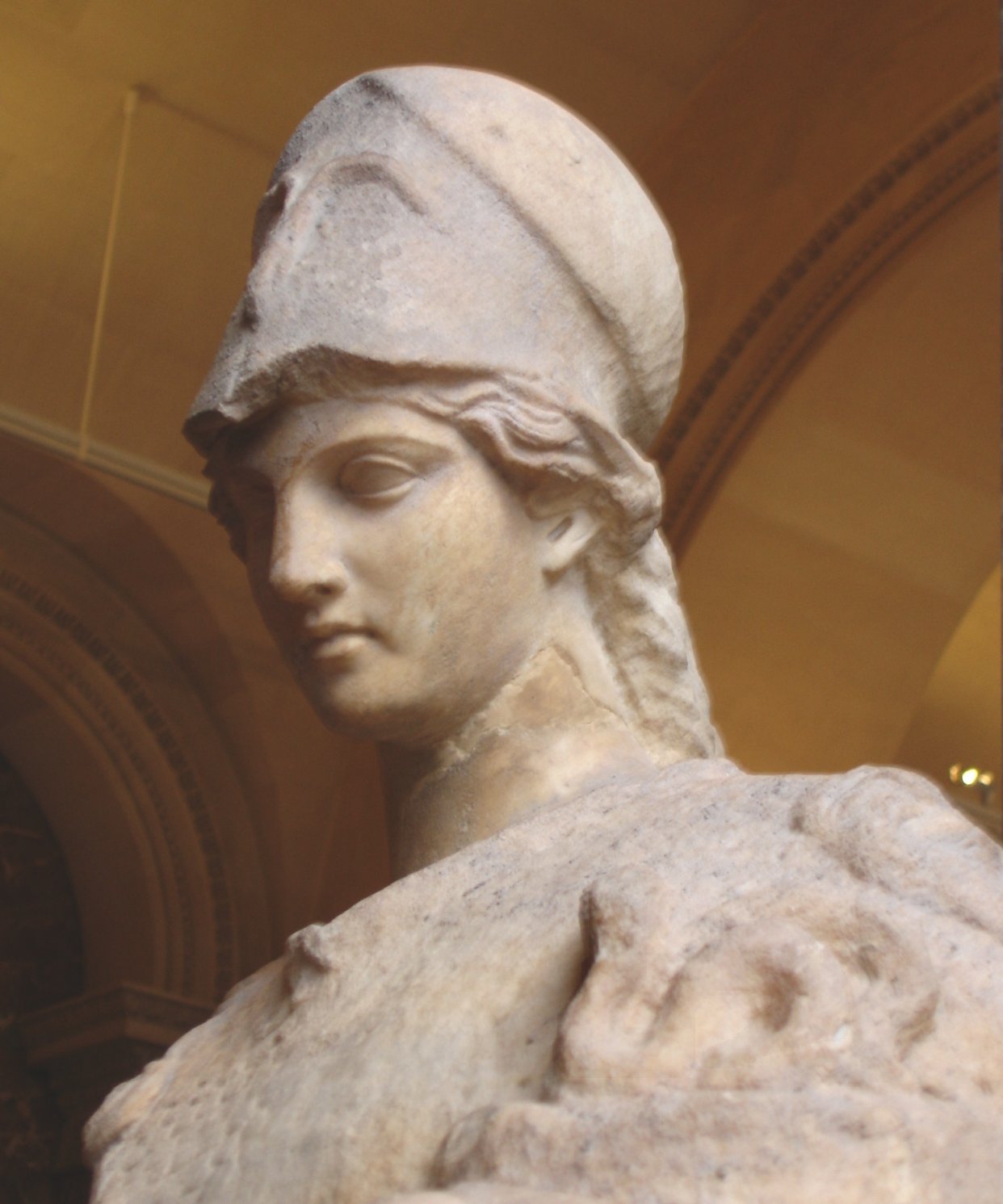
Perched upon a bust of Pallas just above my chamber door -
Perched, and sat, and nothing more.

Then this ebony bird beguiling my sad fancy into smiling,
By the grave and stern decorum of the countenance it wore,
`Though thy crest be shorn and shaven, thou,' I said, `art sure no craven.
Ghastly grim and ancient raven wandering from the nightly shore -
Tell me what thy lordly name is on the Night's Plutonian shore!'
Quoth the raven, `Nevermore.'


Much I marvelled this ungainly fowl to hear discourse so plainly,
Though its answer little meaning - little relevancy bore;
For we cannot help agreeing that no living human being
Ever yet was blessed with seeing bird above his chamber door -
Bird or beast above the sculptured bust above his chamber door,
With such name as `Nevermore.'

But the raven, sitting lonely on the placid bust, spoke only,
That one word, as if his soul in that one word he did outpour.
Nothing further then he uttered - not a feather then he fluttered -
Till I scarcely more than muttered `Other friends have flown before -
On the morrow he will leave me, as my hopes have flown before.'
Then the bird said, `Nevermore.'

Startled at the stillness broken by reply so aptly spoken,
`Doubtless,' said I, `what it utters is its only stock and store,
Caught from some unhappy master whom unmerciful disaster
Followed fast and followed faster till his songs one burden bore -
Till the dirges of his hope that melancholy burden bore
Of "Never-nevermore."'

But the raven still beguiling all my sad soul into smiling,
Straight I wheeled a cushioned seat in front of bird and bust and door;
Then, upon the velvet sinking, I betook myself to linking
Fancy unto fancy, thinking what this ominous bird of yore -
What this grim, ungainly, ghastly, gaunt, and ominous bird of yore
Meant in croaking `Nevermore.'

This I sat engaged in guessing, but no syllable expressing
To the fowl whose fiery eyes now burned into my bosom's core;
This and more I sat divining, with my head at ease reclining
On the cushion's velvet lining that the lamp-light gloated o'er,
But whose velvet violet lining with the lamp-light gloating o'er,
She shall press, ah, nevermore!

Then, methought, the air grew denser, perfumed from an unseen censer
Swung by Seraphim whose foot-falls tinkled on the tufted floor.
`Wretch,' I cried, `thy God hath lent thee - by these angels he has sent thee
Respite - respite and nepenthe from thy memories of Lenore!
Quaff, oh quaff this kind nepenthe, and forget this lost Lenore!'
Quoth the raven, `Nevermore.'

`Prophet!' said I, `thing of evil! - prophet still, if bird or devil! -
Whether tempter sent, or whether tempest tossed thee here ashore,
Desolate yet all undaunted, on this desert land enchanted -
On this home by horror haunted - tell me truly, I implore -
Is there - is there balm in Gilead? - tell me - tell me, I implore!'
Quoth the raven, `Nevermore.'

`Prophet!' said I, `thing of evil! - prophet still, if bird or devil!
By that Heaven that bends above us - by that God we both adore -
Tell this soul with sorrow laden if, within the distant Aidenn,
It shall clasp a sainted maiden whom the angels named Lenore -
Clasp a rare and radiant maiden, whom the angels named Lenore?'
Quoth the raven, `Nevermore.'


`Be that word our sign of parting, bird or fiend!' I shrieked upstarting -
`Get thee back into the tempest and the Night's Plutonian shore!
Leave no black plume as a token of that lie thy soul hath spoken!
Leave my loneliness unbroken! - quit the bust above my door!
Take thy beak from out my heart, and take thy form from off my door!'
Quoth the raven, `Nevermore.'

And the raven, never flitting, still is sitting, still is sitting
On the pallid bust of Pallas just above my chamber door;
And his eyes have all the seeming of a demon's that is dreaming,
And the lamp-light o'er him streaming throws his shadow on the floor;
And my soul from out that shadow that lies floating on the floor
Shall be lifted - nevermore!

~Edgar Allan Poe


**Sorry for the size of the images, but I don't have a way to shrink them at the moment. I'll try to remember to fix it when I get home. Fixed. All but the illustration directly above came from Wikimedia commons, and all link to their sources.**

Inquire Further

30 October 2008

English Usage Quiz

Aaaand... both of the two that I missed were ones I just wasn't sure about, and so I guessed. Incorrectly as it turns out. But they were the only ones I had any doubts on.

Your result for The Commonly Confused Words Test...

English Genius

You scored 100% Beginner, 100% Intermediate, 100% Advanced, and 80% Expert!


You did so extremely well, even I can't find a word to describe your excellence! You have the uncommon intelligence necessary to understand things that most people don't. You have an extensive vocabulary, and you're not afraid to use it properly! Way to go!


Thank you so much for taking my test. I hope you enjoyed it!


For the complete Answer Key, visit my blog: http://shortredhead78.blogspot.com/.

Take The Commonly Confused Words Test at HelloQuizzy


Inquire Further

4-Variables

I found this here while bloghopping this morning. The numbers...look about right to me. Except that I tend to group "verbal" and "mathematical" together in my head.

Your result for The 4-Variable IQ Test...

Mathematical

10% interpersonal, 25% visual, 25% verbal and 40% mathematical!


Brother-from-another-mother! Like mine, your highest scoring intelligence is Mathematical. You thrive on logic, numbers, things representing numbers, and sets of things that are sets of other things, with numbers nowhere in sight. You probably like the online comic called XKCD, and if you don't, check it out.


You probably knew you'd score "Mathematical" as you took the test, and mathy types are usually super-high scorers on this axis, and low on the others. Why? Because you (we) yearn for math.


Anyway, your specific scores follow. On any axis, a score above 25% means you use that kind of thinking more than average, and a score below 25% means you use it less. It says nothing about cognitive skills, just your interest.


Your brain is roughly:


10% Interpersonal


25%Visual


25%Verbal


40%Mathematical


Matching Summary: Each of us has different tastes. Still, I offer the following advice to the world.


1. Don't date someone if your interpersonal percentages differ by more than 20%.


2. Don't be friends with someone if your verbal percentages differ by more than 25%.


3. Don't have sex with someone if your math scores differ by over 40%. You might kill them.

Take The 4-Variable IQ Test at HelloQuizzy


Inquire Further

29 October 2008

Illogically InQuined

I've now given my Theory of Knowledge presentation. I think it went well. The other students seemed to think I did too good a job, thereby setting the bar a bit higher than they wanted. Mine was the first student presentation. Amusingly, the other students semi-pushed me into going first as I'm the only one registered in the class as a grad student. Not a grad student in philosophy, admittedly, but I just shrugged and went for it. I read W. V. Quine's article Two Dogmas of Empiricism and presented an overview of it.

A bit of background. There's been a fairly consistent dichotomy in theory of knowledge between what Hume called "truths of reason" and "truths of fact." There have been different names applied to these, and some will argue that the different names don't always describe exactly the same ideas. Nonetheless, they can be thought of as two broad categories. In one category are the things that we know from observation and experiment (synthetic). In the other are the things that we know independently of observations and experiment (analytic). How we know those things is also a matter of debate.

Quine argues, essentially, that this is a false dichotomy. He sees it more as a continuous variation rather than an either/or. Given the meaning of the logical particles, he would agree that "all bachelors are bachelors" would be true independently of the meaning of "bachelors," but not that "all unmarried men are bachelors" is equally clear. It depends on "synonymy", and synonymy depends on definitions, which are determined by usage not by the words themselves. So Quine would argue that there's an empirical component any time a truth depends on what a word means (when that word is not a particular logical particle with a well-defined function).

He doesn't think that paring down to a simplified language lacking in synonyms makes things any better. Simplified languages typically start with a list of "semantic rules," and these rules tell us which statements of the language will be analytic, but get us no closer to figuring out what it is in a general language that makes a statement analytic. In fact, it's circular to try and use the simplified language, as the semantic rules are usually constructed so that they will preserve "analyticity" of statements between the languages. So you need to know which statements of the original language are analytic even to construct the simplified language.

Quine's last attempt to decipher the analytic is to apply "verification theory" to it. Verification theory is the idea that a statement's actual meaning is in the method that one would use to verify it. So the meaning of "the mail has come" is that I go out and look in the mailbox to see if I'm right or not. However, this seems to presuppose the analytic/synthetic distinction, in that the analytic statements, presumably, are not in need of empirical verification. Or are they? Any that depend on "synonymy", according to Quine, are in need of empirical verification.

The problem is that there is no particular reason that "king" means "male who is in charge of a certain area of land and all within that land" instead of meaning, for instance, "miter saw." That "king" has the meaning that it does is an "accidental matter of fact." And word usage changes constantly. Quine will eventually conclude that the language itself is the unit of meaning (raising issues of translation, and of how it's even possible for two people to communicate in the same language), but I think that the lesser point is a valid one. At one level, within the context of a language semi-frozen at a moment in time, there will be "analytic" statements, but they do depend on both the language and the time-frame. At another level, once the ideas behind the words are understood, the logical relations will hold regardless of the words, but there's no reason to think that the logical structure is fixed, either. There are multiple logics that are useful in different instances. For one example, see Quantum Logic.

Inquire Further

Says It All, Really...


What I particularly like about this one is pondering how that sign was written and attached whilst the pilot was unconscious. I envision a passenger finding a blank sign and a sharpie, then boldly climbing out to the end of the tail to attach it. Hopefully s/he made it back into the plane. Then again, maybe the plane had an R2-unit installed... ^/^

More Bizarro here

Inquire Further